
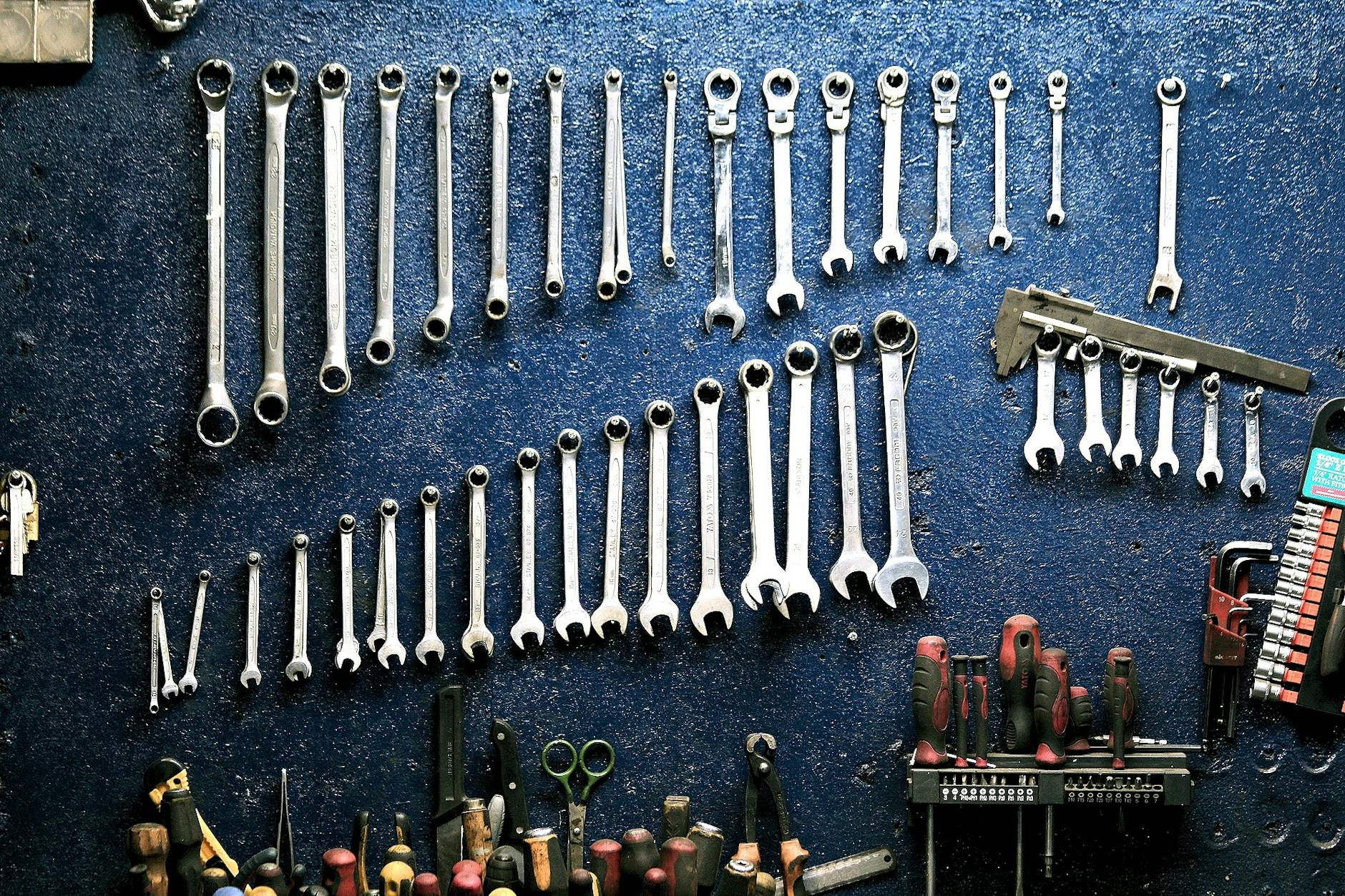
You can do the bulk of routine servicing on a motorbike, a bicycle and a petrol garden tool with a surprisingly small set of tools. What separates a useful toolbox from a cluttered one isn't the number of items: it's the quality of the few tools that touch critical fasteners, and the presence of two or three measuring instruments.
Here's the list, in the order you should buy it.
The common core — the first hundred pounds
These tools earn their keep in all three areas. This is the foundation.
- Combination spanner set, 8 to 19 mm. The sizes you'll actually reach for: 8, 10, 12, 13, 14, 17.
- 3/8 ratchet with 8 to 19 mm sockets, plus an extension bar and a universal joint. The 3/8 covers almost everything; the 1/2 is for high torques (wheels, sprocket nut), the 1/4 for small fasteners.
- Hex (Allen) key set, 2 to 10 mm, long type with ball ends. It's the most heavily used tool on a bicycle and on any modern machine.
- Torx set, T10 to T50. Increasingly common on motorbikes and garden machinery.
- Flat and cross-head screwdrivers, two sizes of each, with tips that don't round off.
- Water-pump pliers, side cutters, long-nose pliers.
- Nylon mallet.
- Adjustable spanner — for anything without a standard size, not as a substitute for a proper spanner.
The rule on this core: buy decent rather than expensive. A soft Allen bit rounds the bolt before it gives way itself, and a rounded bolt in a casing turns a ten-minute job into a project.
Measuring instruments — the real step up
This is where the difference between tinkering and servicing gets decided.
The torque wrench (£35 to £100). Non-negotiable the moment you touch aluminium, carbon, a cylinder head or a wheel. Two ranges cover the essentials:
- 2–20 Nm for bicycles, stem clamps, fairing bolts, small-engine spark plugs.
- 20–110 Nm for motorcycle wheel spindles, head bolts, sprocket nuts.
A single wide-range wrench works badly at both ends of its scale. If the budget stretches to only one, buy the one that matches your main area.
The multimeter (£15 to £50). Battery voltage, charging voltage, continuity through a loom, coil resistance. It turns an electrical diagnosis from guesswork into measurement.
Vernier calipers (£15 to £35). Disc and pad thickness, spindle diameter, wear limits. A £20 digital pair is more than enough.
A pressure gauge — for motorcycle or bicycle tyres depending on your area. Forecourt gauges are notoriously inaccurate.
A chain wear indicator (£10 for a bicycle, a steel rule for a motorbike). The best money saved per pound spent on the whole list: it stops you paying for a complete transmission instead of a chain.
The consumables to keep in stock
Without them, a planned job stops halfway:
- Medium (blue) and high-strength (red) threadlock.
- Multi-purpose lithium grease and copper grease for assemblies that see heat.
- Carbon assembly paste if the bike has carbon parts.
- Brake cleaner, degreaser, lint-free cloths.
- Cable ties, heat-shrink sleeving, decent insulating tape.
- An assortment of stainless fasteners in the common sizes.
- Nitrile gloves and safety glasses.
The five specialist tools worth buying
Plenty of specialist tools can be hired, borrowed, or found on loan at some dealers. Five are the exception, because you use them twice a year and hiring costs nearly as much as buying:
- The motorcycle paddock stand or the bicycle work stand (£50 to £175). It isn't a comfort item: it's what makes chain lubrication, brake bleeding and gear indexing come out right.
- The chain tool for your area — bicycle or motorbike. Two different tools; neither one replaces the other.
- The puller or key for whatever comes up most in your area: crank puller or bottom-bracket tool on a bicycle, oil filter wrench on a motorbike, long plug spanner on garden machinery.
- The vacuum pump or brake bleed kit (£20 to £50). A clean bleed changes braking feel more than any pad ever will.
- The battery maintainer — technically not a tool, but it prevents more breakdowns than everything else combined.


