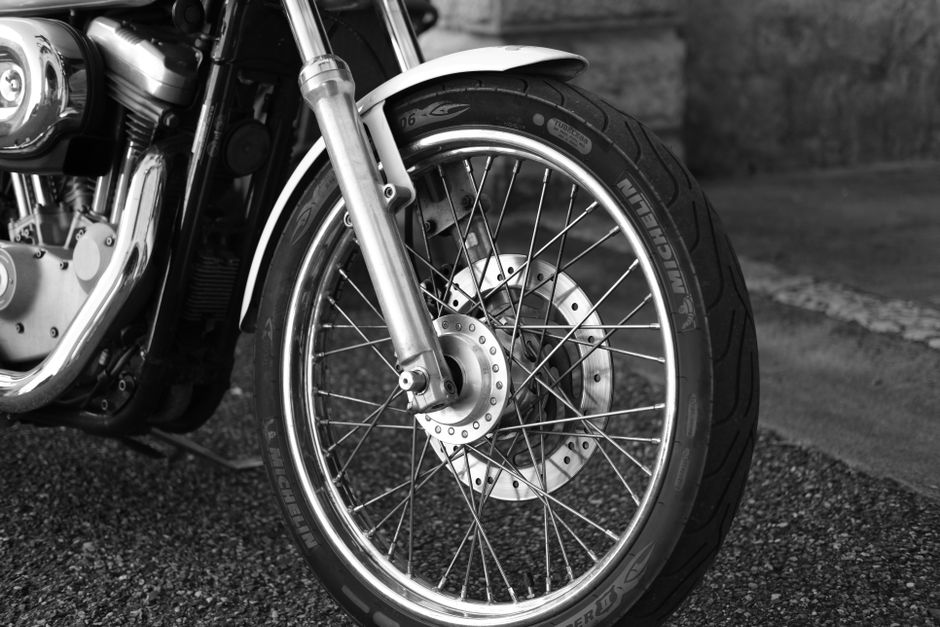
Fork preload is a setting that's too often neglected even though it takes 5 minutes flat and radically changes the bike's behavior. Yet I still see riders rolling around with completely off-base SAG - forks diving 60 mm under braking or conversely, staying hard as concrete. Preload adjustment is the foundation even before touching compression or rebound. We'll look at how to properly measure SAG and adjust preload according to your weight and usage.
Understanding SAG and preload
SAG is the fork's compression under the rider's weight. It's measured in millimeters and represents the difference between the fully extended fork and the fork with you on it, in normal riding position. On a modern bike, total fork travel ranges from 110 mm on a sport bike like the Yamaha R1 to 200 mm on an adventure bike like the BMW R1250GS.
Preload is the initial spring tension. The more you increase preload, the more you compress the spring at rest, and the less it will sag under your weight. It's the only parameter that directly influences SAG without modifying the fork's dynamic behavior (unlike compression/rebound settings which affect travel speed).
Correct SAG ensures you use all your fork's available travel. Too much SAG (over 40 mm on the road), and your fork will bottom out under hard braking. Not enough (less than 20 mm), and it'll stay in the first third of its travel, losing grip and comfort.
"Preload doesn't make the suspension harder or softer. It only changes ride height and SAG. If your fork feels too hard, it's the compression setting you need to adjust, not the preload." - Kevin Cameron, suspension technician
Measuring SAG correctly
To measure SAG, you need a caliper or simple ruler, a zip-tie or adhesive tape, and a mate to hold the bike upright. Count 3 minutes max to take the three necessary measurements.
L1 - Fork fully extended: Put the bike on a front stand (or have your mate lift it). Measure the distance from the bottom of the triple clamp (or top of the outer tube) to the bottom of the slider. On a Kawasaki Z900 for example, you'll find about 680 mm. Note this value.
L2 - Bike unladen: Put the bike on its wheels, with nobody on it. Re-measure the same distance. The fork has compressed under the bike's weight. You'll find about 650 mm on our Z900. The difference (30 mm) represents static SAG - you can ignore it for adjustment.
L3 - With rider: Put on your complete gear (jacket, helmet, boots), get on the bike in normal position (standing on the footpegs for an adventure bike, seated for a sport bike), and have yourself measured while your mate holds the bike upright. Get off, get back on, pump the fork 3-4 times to eliminate friction. Take the final measurement. On the Z900 with a 75 kg rider, you should have about 610 mm.
Rider SAG = L2 - L3. In our example: 650 - 610 = 40 mm. This is the figure that counts.
Target values according to usage
Ideal SAG values depend on your riding type and your bike. On the road, suspensions work mainly in compression under braking and load transfer. Off-road, they must absorb repeated impacts and work through their entire travel.
Road and sport: Aim for 25-30% of total travel. For a fork with 120 mm of travel, that gives 30-36 mm of SAG. A Ducati Panigale V4 (120 mm of travel) ideally sets at 32 mm. An MT-09 (137 mm) sits between 34 and 41 mm depending on rider weight.
Adventure and all-rounder: Go up to 30-35% to maintain road responsiveness while having travel reserve. A Honda Africa Twin (230 mm of travel) sets between 69 and 80 mm. A Yamaha Ténéré 700 (210 mm) between 63 and 73 mm.
Pure enduro: Push up to 35-40% to maximize usable travel in ruts. A KTM 300 EXC (300 mm front) can go up to 105-120 mm of SAG.
These values change with luggage. Add 3-5 mm of SAG per 10 kg of loading in side panniers. With 20 kg of distributed luggage, you'll easily gain 8 mm of SAG on an adventure bike - you then need to increase preload by half a turn.
Adjusting preload: conventional vs inverted fork differences
Conventional forks (internal chrome slider tube at bottom, outer tube at top) and inverted forks (upside-down, slider at top) adjust differently. On conventional forks, the spring is compressed by a preload system at the top of the tube, accessible after removing the upper cap. On modern inverted forks, the adjustment collar is often external.
Conventional forks (Yamaha XSR700, Honda CB500X type):
The most common system uses preload spacers. You must unscrew the upper cap (torque setting generally between 20 and 25 N·m), remove the spring, and add or remove preload washers. Each 5 mm washer modifies SAG by about 3-4 mm. Allow 15 minutes per side if you need to change spacers.
Some conventional forks have a preload screw accessible through the upper cap - much faster. You unscrew the cap, turn the central screw with a 6 or 8 mm Allen key. One complete turn modifies SAG by about 2-3 mm.
Inverted forks with external adjustment (Yamaha R1, Suzuki GSX-R1000, KTM Duke 890 type):
The adjustment collar is visible at the top of the tube. You turn it by hand or with a hook wrench depending on the model. Each click modifies preload by about 1 mm of SAG. These systems allow adjustment in 2 minutes flat without tools.
On a latest generation Yamaha R1, you have 19 preload positions. Position 1 (minimum) gives about 38 mm of SAG for a 70 kg rider, position 10 (median) about 30 mm, position 19 (maximum) about 22 mm. Always start at the median position.
High-end inverted forks (Öhlins, Showa BPFSC, Marzocchi):
Adjustment is via a graduated dial at the top of the tube. The dial often indicates preload in millimeters of spring compression (not SAG). A 10 mm setting on the dial does NOT correspond to 10 mm of SAG - it's more like a 1:2 ratio. To decrease SAG by 5 mm, you increase preload by 10 mm on the dial.
Tools and complete procedure
For a complete preload adjustment, prepare your gear:
- Caliper or graduated ruler (minimum 1 mm precision)
- Zip-ties or wide tape
- Torque wrench (if disassembly necessary)
- Allen key or hook wrench depending on system
- Compatible fork oil (if taking advantage of disassembly to check level)
- Clean cloth
Quick procedure for external adjustment fork:
- Measure your current SAG (3 minutes)
- Compare with target value
- If SAG too high: increase preload (generally clockwise). Quick calculation: to lose 5 mm of SAG, turn 5 clicks on external adjustment
- If SAG too low: decrease preload (counterclockwise)
- Re-measure after each adjustment - don't make 10 turns at once
Procedure for spacer fork:
- Measure current SAG
- Calculate correction: if you're at 45 mm and want 32 mm, you need to lose 13 mm
- Count about 3 mm of SAG per 5 mm washer → you need to add 4 washers (or 20 mm of spacers)
- Remove upper cap (watch for spring pressure), remove spring
- Add or remove spacers
- Reinstall spring, tighten cap to torque (20-25 N·m depending on model)
- Re-measure SAG
A pro tip: note your settings with permanent marker on the triple clamp. "SAG 32 mm - preload +3" for example. After 6 months or a tire change that modifies geometry, you'll know where you started from.
Watch for common pitfalls:
- Different SAG between the two tubes (sign of springs or uneven wear)
- Leaking fork seals = friction = false SAG measurement
- Fork sticking after winter = clean tubes before measuring
- Forgetting to measure in complete gear (15 kg difference between jeans and leather gear)
If after adjustment your SAG remains off target with preload at minimum or maximum, your spring isn't suited to your weight. A 95 kg rider on an MT-07 will need stiffer springs (0.95 N/mm instead of the stock 0.85 N/mm, about €180 for a pair from Hyperpro).
In summary
Measure your SAG accurately: three measurements (fork extended, bike alone, with equipped rider), aim for 25-30% of travel for road, 30-35% for adventure. On 120 mm of travel, that gives 30-36 mm road SAG.
Adjust preload according to your system: external adjustment in 2 minutes on modern inverted forks (one click = about 1 mm of SAG), 15 minutes per fork for spacer systems (one 5 mm washer = 3 mm of SAG).
Check and adapt according to use: add half a turn of preload per 10 kg of luggage, re-measure after any major modification (tires, heavier rider), and change springs if you hit adjustment stops without reaching your target SAG.