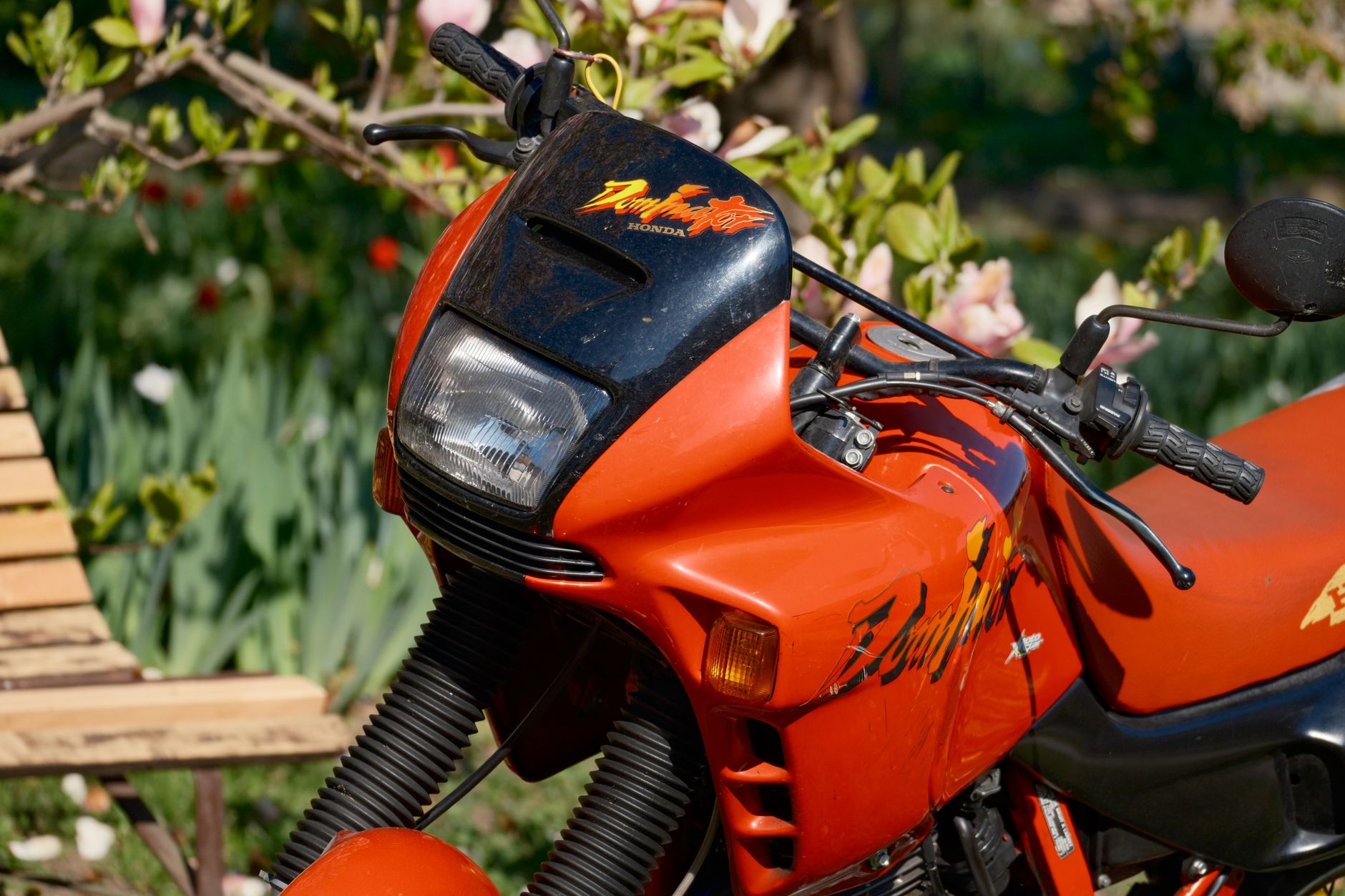
The Honda NX 650 Dominator marked fifteen years of production between 1988 and 2003, with its 644 cm³ RFVC (Radial Four Valve Combustion) single-cylinder engine. This radial four-valve configuration delivered 46 horsepower at 6000 rpm and 56 N·m of torque at 5000 rpm. The engine block tilted 40° forward and the air/oil cooling ensure excellent mechanical simplicity, but this machine requires rigorous maintenance to go the distance.
Essential Maintenance Intervals
Maintaining the Honda single-cylinder follows clear logic. Oil changes occur every 5000 km with 2.7 liters of 10W40 semi-synthetic oil. The dry sump requires a precise level between marks on the inspection window, with the engine vertical and warm.
The oil filter is located behind the right cover, accessible after removing the footpeg. Replacing the cartridge every 10000 km is sufficient with this robust engine. The cover O-ring deserves simultaneous replacement to avoid seepage.
The frequency of major operations:
- Valve clearances: check every 12000 km (intake 0.10 mm, exhaust 0.13 mm cold)
- Air filter: cleaning every 6000 km, replacement every 12000 km
- NGK DPR8EA-9 spark plug: replacement every 8000 km, torque 13 N·m
- CV40 carburetor: annual cleaning or every 15000 km
- Chain: tension every 1000 km, lubrication every 500 km
The overhead camshaft timing system requires rigorous checking. The adjustment shims are located under the cylinder head covers after removing the tank. Top dead center is marked by the line on the flywheel crown visible through the left crankcase opening.
"The RFVC doesn't tolerate incorrect valve clearances. An exhaust valve that's too tight will burn in 10000 km. An intake that's too loose loses 15% power and increases consumption."
Keihin CV40 Carburetor and Settings
The 40 mm constant depression carburetor equips all European versions. The idle mixture screw is located under the left plastic cover, with a factory setting of 2.5 turns from the seat. The #130 main jet suits the standard setup, the #42 pilot jet manages low revs.
The airbox incorporates a high-density foam filter. Removal requires removing the seat, disconnecting the breather hose and unscrewing the four mounting screws. The gasket between box and carburetor often cracks after 40000 km, causing air leaks and hesitation on acceleration.
Carburetor misadjustment symptoms:
- Unstable idle between 800 and 1500 rpm: clean the pilot circuit
- Flat spot between 3000 and 4000 rpm: check the slide diaphragm
- Consumption over 6 liters/100 km: check the float level (16 mm below joint face)
- Difficult cold starting: enricher faulty or cable seized
Complete disassembly takes 45 minutes. Bowl, jets and passages are cleaned with carb cleaner and compressed air. The slide diaphragm costs around 35€ from Honda, the complete gasket kit around 25€. The return spring loses tension after 60000 km and deserves replacement.
Recurring Weak Points
The alternator is the Dominator's Achilles' heel. The three-phase stator suffers from engine heat and typically fails between 40000 and 60000 km. Symptoms appear gradually: weak lighting, battery draining, stalling at idle. Testing is done with a multimeter, each winding should show between 0.1 and 1 ohm resistance.
Replacing the stator requires removing the left crankcase cover. The complete kit with regulator costs between 180€ (compatible) and 350€ (Honda original). The crankcase gasket costs 15€, also allow for 700 ml of oil for reassembly. The operation takes about 3 hours for an amateur mechanic.
The electric starter also wears. The brushes wear out, the commutator blackens. Honda issued an improvement on post-1992 models with reinforced brushes. A rebuilt starter costs 120€, new 280€. Removal requires access through the right crankcase.
Common failures and solutions table:
| Problem | Cause | Solution | Indicative Price |
|---|---|---|---|
| Weak alternator | Burnt stator | Replace stator + regulator | 180-350€ |
| Slow starter | Worn brushes | Repair kit or exchange standard | 120-280€ |
| Cylinder head cover seepage | O-rings | Replace seals (x8) | 25€ |
| Slipping clutch | Worn plates (< 2.8 mm) | Friction and steel plate kit | 90€ |
| Leaking forks | Oil seals | Seal kit + 15W oil (590 ml/leg) | 45€ |
The steering head bearings seize after 50000 km without maintenance. Play is detected by lifting the front wheel and shaking laterally. Replacement requires a press and appropriate sockets. Allow 60€ for bearings and 2 hours of work.
The exhaust pipe fasteners seize in the cylinder head alloy. Preventive treatment with copper anti-seize at each oil change avoids this issue. After 70000 km, the original stainless collector typically punctures at the flange gasket. Compatible Dominator exhausts start at 220€.