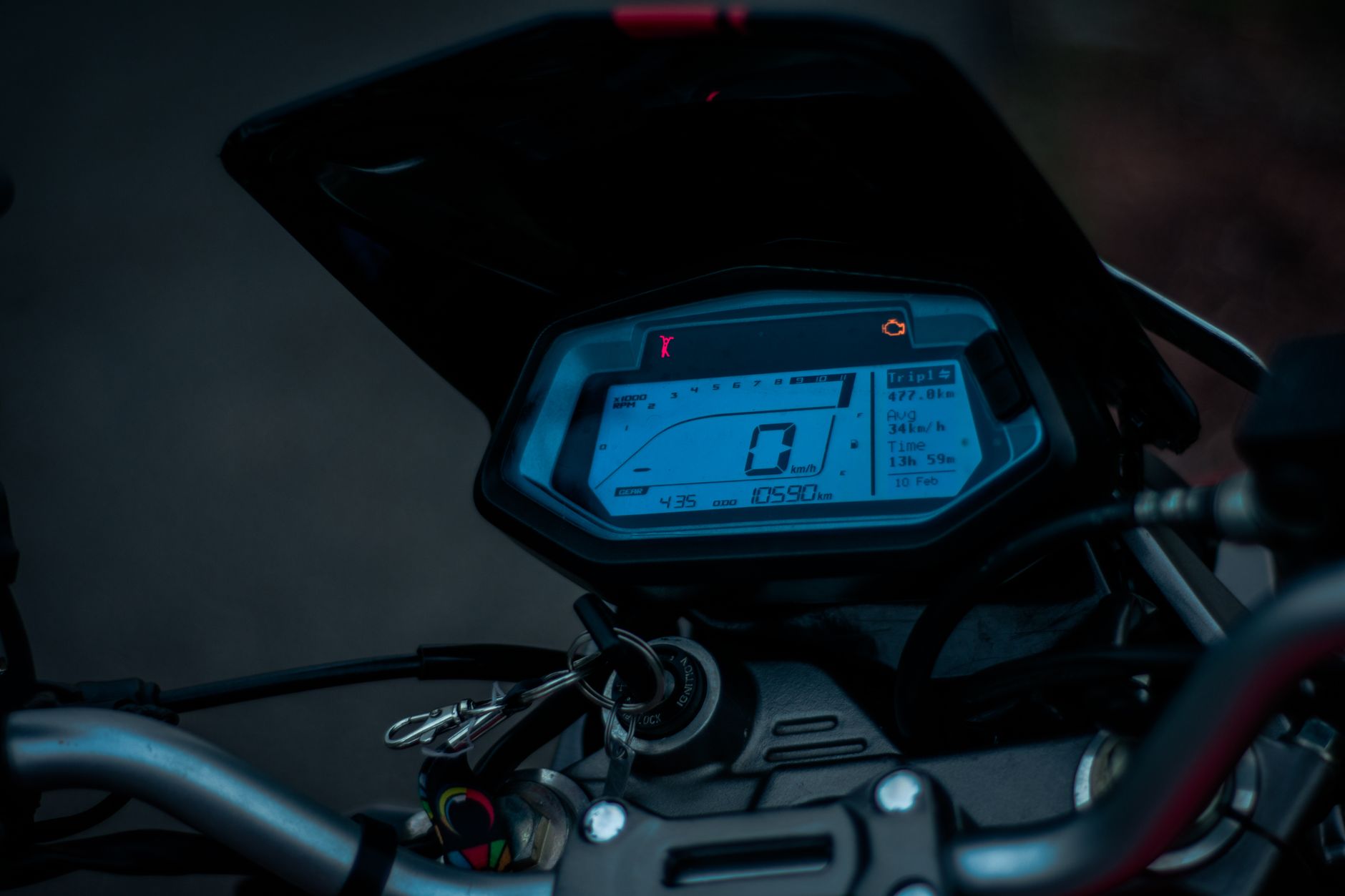
Recent CFMoto road bikes, the 450MT, 700CL-X, 800MT and their relatives, use Bosch fuel injection. When the ECU detects a fault, the engine light comes on and, according to reports posted on the owners' forum, the dash can show a code such as P013000 or P109800. The format looks intimidating; it is actually very readable, as long as you know what is standardised and what is not.
Before reading a code: two warning lights not to confuse
- The engine light (stylised engine, sometimes "EFI"): injection, ignition, sensors, emissions. That is what this article covers.
- The ABS light: braking system, wheel sensors, ABS unit. A different system with a different logic, covered in ABS light on.
Engine light steady and the bike rides normally: stored fault, to be diagnosed without delay. Bike losing power, stuttering or in limp mode: stop and do not push it. The ECU deliberately limits the engine to protect it.
Reading a six-character code
A code such as P013000 reads in three parts:
| Part | Example | Meaning |
|---|---|---|
| Letter | P | Powertrain. B, C and U stand for body, chassis and network |
| Four characters | 0130 | The fault itself. If the first digit is 0, the code is standardised (SAE J2012); if it is 1, it is manufacturer-specific |
| Last two | 00 | The failure type byte. 00 means "no sub-type information" |
In practice: P013000 = P0130, an oxygen sensor circuit fault, with no further detail. And P109800 = P1098, a manufacturer code: its meaning is not in generic lists.
Standardised codes you meet on a fuel-injected twin
P0xxx codes have the same definition at every manufacturer, motorcycles included, since they come from the SAE J2012 standard. Here are the ones that concern components found on a CFMoto road bike. The definitions are the standard's; the causes and order of checks are ours.
| Code | Meaning (SAE J2012) | Likely cause | What to do |
|---|---|---|---|
| P0030 | Oxygen sensor heater control circuit (bank 1, sensor 1) | Sensor heater, loom | Connector, then sensor |
| P0031 | Oxygen sensor heater, circuit low | Short to earth, failed heater | Loom, then sensor |
| P0032 | Oxygen sensor heater, circuit high | Short to positive | Loom, then sensor |
| P0105 | Manifold absolute or barometric pressure circuit | Sensor, connector | Connector, hose, sensor |
| P0107 / P0108 | Manifold pressure: low / high input | Loom, sensor | Loom, then sensor |
| P0112 / P0113 | Intake air temperature: low / high input | Loom, sensor | Connector, then sensor |
| P0117 / P0118 | Engine temperature: low / high input | Sensor, corroded connector | Connector, then sensor |
| P0122 / P0123 | Throttle position sensor A: low / high input | Sensor, loom | Connector, then workshop |
| P0130 | Oxygen sensor circuit (bank 1, sensor 1) | Sensor, loom, air leak | Connector, exhaust, sensor |
| P0131 / P0132 | Oxygen sensor: low / high voltage | Mixture, air leak, sensor | Exhaust and intake, then sensor |
| P0133 | Oxygen sensor: slow response | Ageing sensor, exhaust leak | Sealing, then sensor |
| P0134 | Oxygen sensor: no activity | Dead sensor, broken wire | Connector, sensor |
| P0135 | Oxygen sensor heater circuit | Failed heater | Connector, sensor |
| P0171 / P0172 | System too lean / too rich (bank 1) | Air leak, fuel pressure, injector | Intake, then workshop |
| P0201 / P0202 | Injector circuit, cylinder 1 / 2 | Connector, injector | Connector, then injector |
| P0230 | Fuel pump primary circuit | Relay, fuse, pump | Fuse, relay, loom |
| P0335 / P0336 | Crankshaft position sensor: circuit / range | Sensor, air gap, loom | Connector, then sensor |
| P0351 / P0352 | Ignition coil A / B | Coil, connector | Connector, then coil |
| P0505 | Idle air control system | Fouling, air leak | Workshop (electronic throttle body) |
| P0562 / P0563 | System voltage low / high | Battery, regulator | Battery and charging with a multimeter |
A P0 code not in this table exists in the standard but does not necessarily match a component on your bike. If you see one, note it and have it read with a compatible tool.
P1 codes: caution
P1xxx codes are defined by the manufacturer or by the ECU supplier. CFMoto does not publish a list online; it sits in the dealer network's workshop manuals. You will find explanations on forums, sometimes right, but to be taken for what they are: interpretations. Example: on the CFMoto forum, a member explains that a P109800 on a 700CL-X Heritage relates to a slow oxygen sensor response during fuel cut-off (throttle closed). Plausible, not an official source, and in the same thread the fault was not solved after several parts were replaced. The lesson: a code points to a circuit, not to a part to replace.
The pressure-washer trap
On the owners' forum, one case comes back: a CForce 450 quad lights its warning lamp after a pressure wash and shows P013000. Water gets into the connectors, especially the oxygen sensor's, which sits near the exhaust, and corrupts the signal. Before anything else, if the light came on just after a wash or a ride in the rain: let it dry, unplug the connector concerned, check the pins, plug it back in, and see if the fault returns after clearing. From then on, wash at low pressure around the loom.