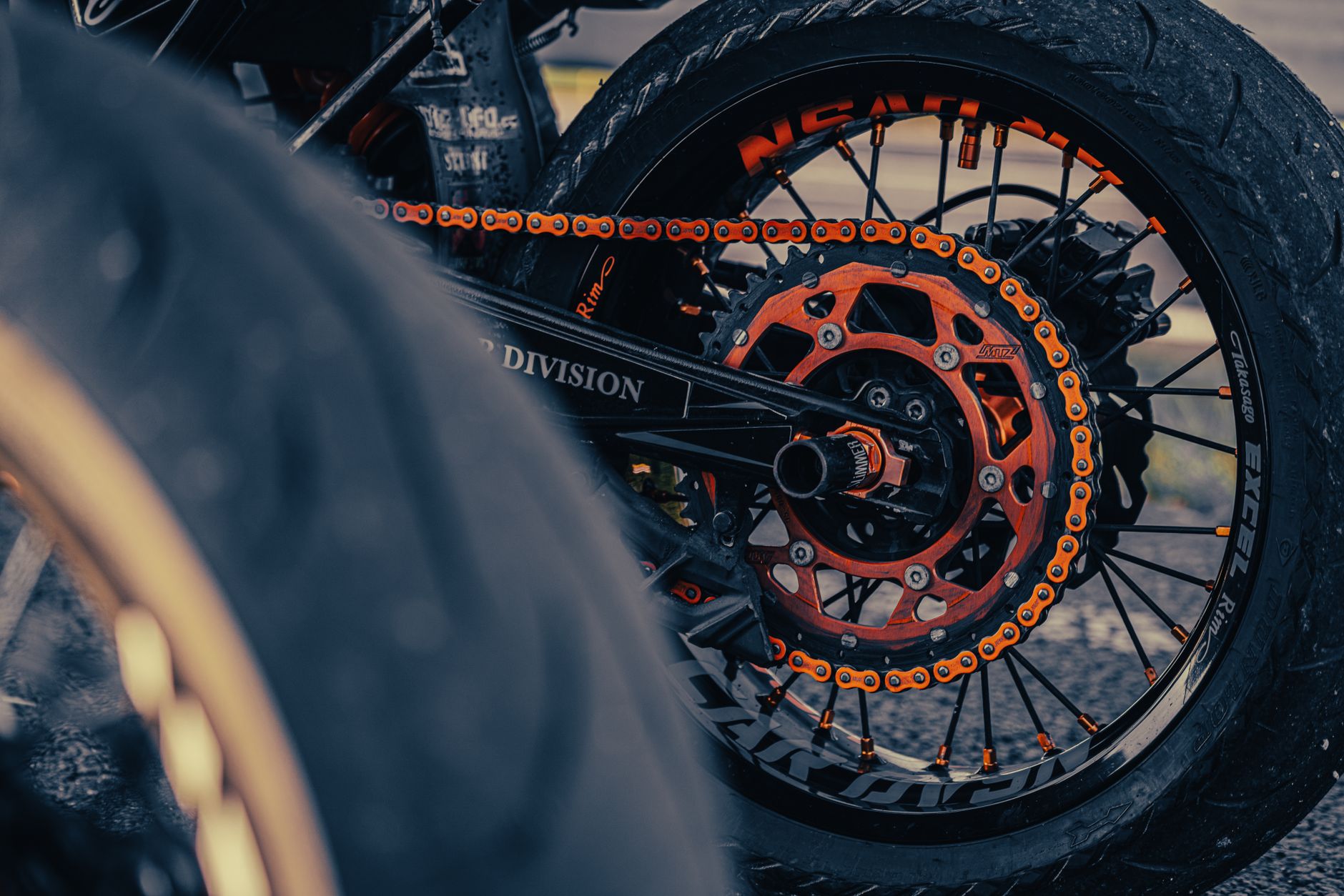

When you order a new chain for your bike, the seller systematically asks: O-ring or X-ring? The price difference is striking – between €80 for a DID O-ring and €150 for its X-ring equivalent on a 600 sportbike. But what justifies this gap? And above all, does it really make a difference on the road?
I've fitted dozens of chains in the workshop, and I can tell you that the choice between O-ring and X-ring isn't just a marketing story. The seal geometry changes everything: lifespan, friction, maintenance. But depending on your use, paying double for X-ring can be completely pointless.
The geometry difference: O round vs X crossed
The O-ring is a simple nitrile rubber ring that fits between the chain plates. Its cross-section is circular, hence the name. It creates two contact points with the inner and outer plates. Its function: prevent grease from escaping and dirt from penetrating the pins and rollers.
The X-ring has an X-shaped cross-section, with four distinct lobes. This geometry creates four contact points instead of two. RK was the first manufacturer to popularize this design in the 90s, quickly followed by DID and EK.
Concretely, when you look closely at a new chain:
- O-ring: round seal, 5.3 mm external diameter on a 520 chain, significant contact surface
- X-ring: seal with four bulges, 4.8 mm external diameter, more localized contact
This geometry difference has direct consequences on three points: sealing, internal friction and durability.
Sealing is better on an X-ring. The four contact points create a double barrier against water and mud spray. When you ride in the rain, water has more difficulty reaching the internal grease. I've disassembled X-ring chains with 25,000 km in mixed conditions: the grease inside was still clean and viscous.
On a classic O-ring, after 15,000 km in the same conditions, the grease begins to oxidize and dilute. It remains functional, but wear accelerates.
Friction and efficiency: the price to pay
Internal friction, that's where it gets interesting. More contact points = more friction, logical. Except the engineers worked on the geometry to limit the damage.
On a standard O-ring chain, the two contact points are wide and create constant resistance. RK announces about 5 watts of loss per link at 100 km/h on their GB series. That represents about 500-600 watts lost on a complete 520 chain with 110 links.
The first generations of X-ring were worse: up to 8 watts per link. The total contact surface was larger. But modern X-rings have changed the game. DID with their ZVM-X series or EK with the MVXZ reduced the lobe size and optimized the rubber. Result: 3.5 to 4 watts per link, 30% less than a classic O-ring.
On the tarmac, how does that translate?
I did the test on my MT-09 with 115 hp at the crank:
- DID VX O-ring chain: 108 hp at the wheel on the dyno
- DID ZVM-X chain: 110 hp at the wheel
2 horsepower difference. On a big sportbike pushing 180 hp, you can recover 3 to 4 horsepower just by changing chains. Track riders know this well – look at the paddocks, almost everyone runs high-end X-ring.
The trade-off: the price. A DID 520VX (O-ring) costs €85 in 110 links. The DID 520ZVM-X (X-ring) goes up to €155. Ratio of 1.8x. At RK, it's the same: the GB520XSO (reinforced O-ring) is €95, the XW-Ring goes up to €165.
Real-world lifespan: figures from the field
Manufacturers announce 20,000 km for a standard O-ring and 30,000 km for an X-ring. In the workshop, we see something else.
Observed lifespans according to use:
| Chain type | Urban use | Mixed road | Sport/track | Big trail |
|---|---|---|---|---|
| Standard O-ring | 18,000-22,000 km | 15,000-18,000 km | 8,000-12,000 km | 12,000-15,000 km |
| Modern X-ring | 28,000-32,000 km | 24,000-28,000 km | 15,000-20,000 km | 20,000-25,000 km |
The gain is clear, especially in harsh conditions. I have a customer who does track days every month on his R6. With RK O-rings, he changed every 10,000 km. Since he switched to EK SRX-2 (racing X-ring), he's getting 18,000 km with the same pace.
Wear is easy to measure: you check elongation. A new 520 chain measures 3,200 mm for 100 links (pitch of 15.875 mm × 100). Beyond 3,220 mm, or 20 mm elongation, it's done. The seals are shot, the pins are ovalized.
"A chain that stretches too much eats the sprockets. And then you're not just replacing the chain at €120, but the complete kit at €350. Saving money on the chain quickly becomes stupid." — Marc, workshop manager at a Yamaha dealer for 15 years
On high-torque bikes, the gap widens even more. An MT-10 develops 111 N·m at 9000 rpm. With each hard acceleration, the chain takes enormous stress. Classic O-rings deform faster, grease leaks, pins wear. I've seen O-ring chains worn out at 8,000 km on sportily-ridden MT-10s.
Same bike, same rider, with an RK XW-Ring: 22,000 km before replacement. The €70 premium is amortized three times over.