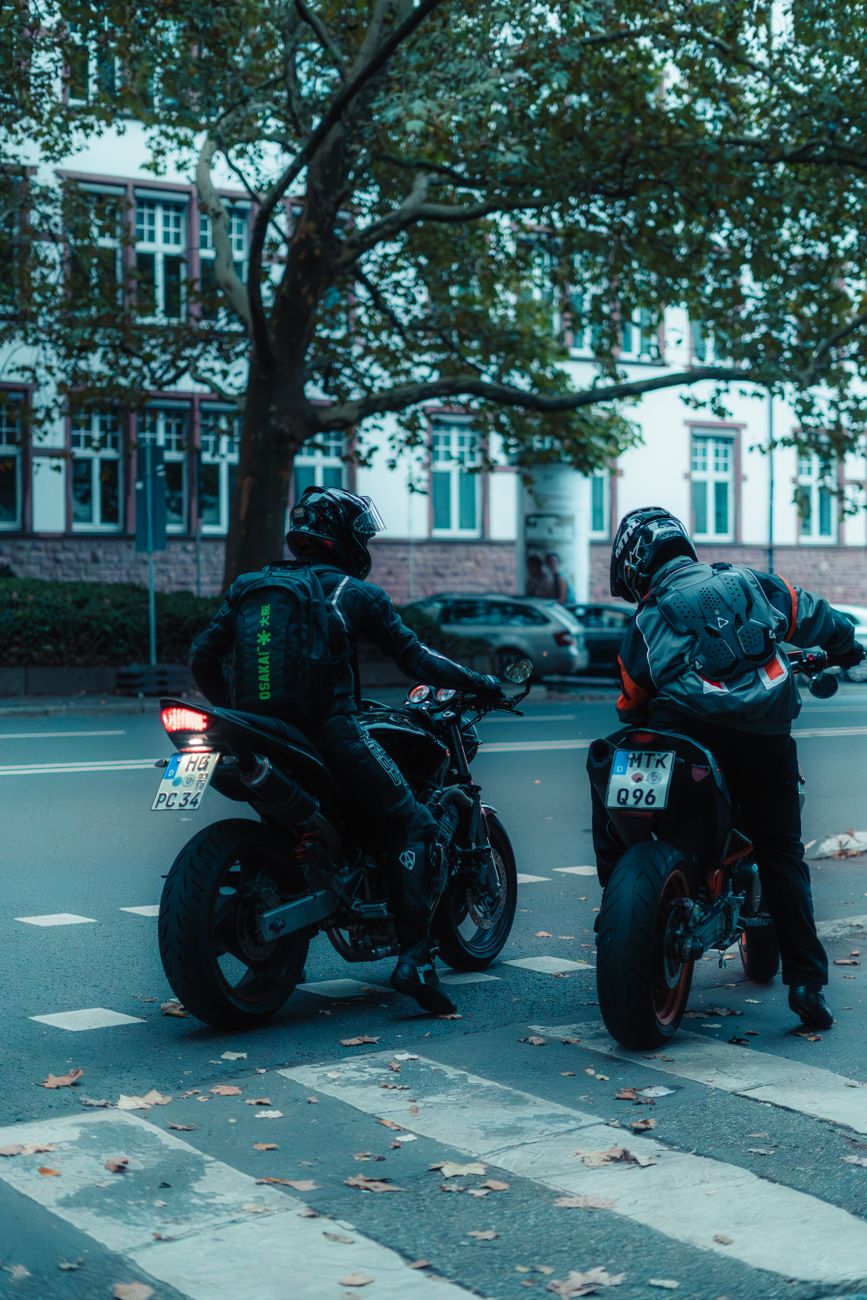
Germany has a solution riders elsewhere envy: the seasonal number plate, which means you only pay insurance for the months you actually ride. Beyond that, the German market is fiercely competitive, run through two giant comparison sites, with a no claims class attached to each vehicle and a cancellation calendar you need to know. Here is how to read a German policy, whether you live there, are registering a bike there or want to understand what a seller means by "Vollkasko until 2027".
The legal minimum: Kfz-Haftpflicht
Third-party liability insurance, Kfz-Haftpflichtversicherung, is compulsory under the Compulsory Insurance Act (Pflichtversicherungsgesetz). Its minimum amounts are above the EU floor:
| Type of damage | Legal minimum per claim |
|---|---|
| Personal injury (Personenschäden) | €7.5 million |
| Property damage (Sachschäden) | €1.3 million |
| Pure financial loss (Vermögensschäden) | €50,000 |
In practice most policies offer much higher limits (often a flat €100 million, with a cap per injured person). Check that figure: it is what protects you after a serious accident, especially abroad.
The three levels: Haftpflicht, Teilkasko, Vollkasko
| Level | What it covers | For which bike |
|---|---|---|
| Haftpflicht | Damage you cause to others | Older or low-value bike |
| Teilkasko | Haftpflicht + theft, fire, explosion, storm, hail, lightning, flood, collision with game, glass, wiring short circuit | Mid-value bike; the most common level |
| Vollkasko | Teilkasko + damage you cause to your own bike (crash, at-fault accident) and vandalism | New, recent, financed or leased bike |
The point that surprises riders from other countries: Teilkasko does not pay for a crash. If you slide off alone on a bend, only Vollkasko pays for your bike. Each level comes with a Selbstbeteiligung (excess), for instance €150 on Teilkasko and €300 to €500 on Vollkasko.
Several insurers add helmet and riding clothing stolen with the bike to Teilkasko (if locked to it or in a locked top box): check the clause. For what full cover still excludes, the logic is the same as elsewhere: see what comprehensive motorbike insurance covers.
The Schadenfreiheitsklasse (SF): Germany's no claims class
The German discount is the Schadenfreiheitsklasse (SF class): the more claim-free years, the higher the class and the lower the premium rate. Three particularities:
- The SF class belongs to each vehicle, not the rider. Your bike has its own class, separate from your car's.
- Scales differ between insurers: there is no single scale for motorbikes, unlike Italy. Two insurers can rate the same history differently.
- Downgrading after an at-fault claim knocks you back several classes at once, depending on the insurer's table.
For new riders, many insurers offer a favourable starting class: borrowing a parent's class (Anlehnung), or a better start if you already have a claim-free car policy (second-vehicle rule, Zweitfahrzeugregelung). These are commercial rules, not law: compare them. A foreign history (a UK no claims letter, French or Italian record) may be accepted with a translation — negotiate.
On pricing: motorbikes have no official Typklasse as cars do (the GDV insurers' association type-class register does not list bike models). Insurers mainly price on power (kW), engine size, your age, your SF class and where you live.
The seasonal plate and Ruheversicherung
The Saisonkennzeichen shows the valid months in small figures, for example 03-10 (March to October). You apply for it at the registration office (Zulassungsstelle) for 2 to 11 months.
- In season, the bike is insured normally and you only pay for those months.
- Out of season, a free Ruheversicherung ("resting" cover) takes over: it usually covers theft and fire (if you have Teilkasko or Vollkasko) while the bike is stored indoors or on private land. It must not be parked on a public road.
- For the year to count towards your SF class, many insurers require a season of at least 6 months. A 04-08 plate is cheaper but can slow your no claims progress.
It is the most effective lever in the German market: a rider who rides from March to October can save several hundred euros a year depending on the policy, according to comparison sites.