
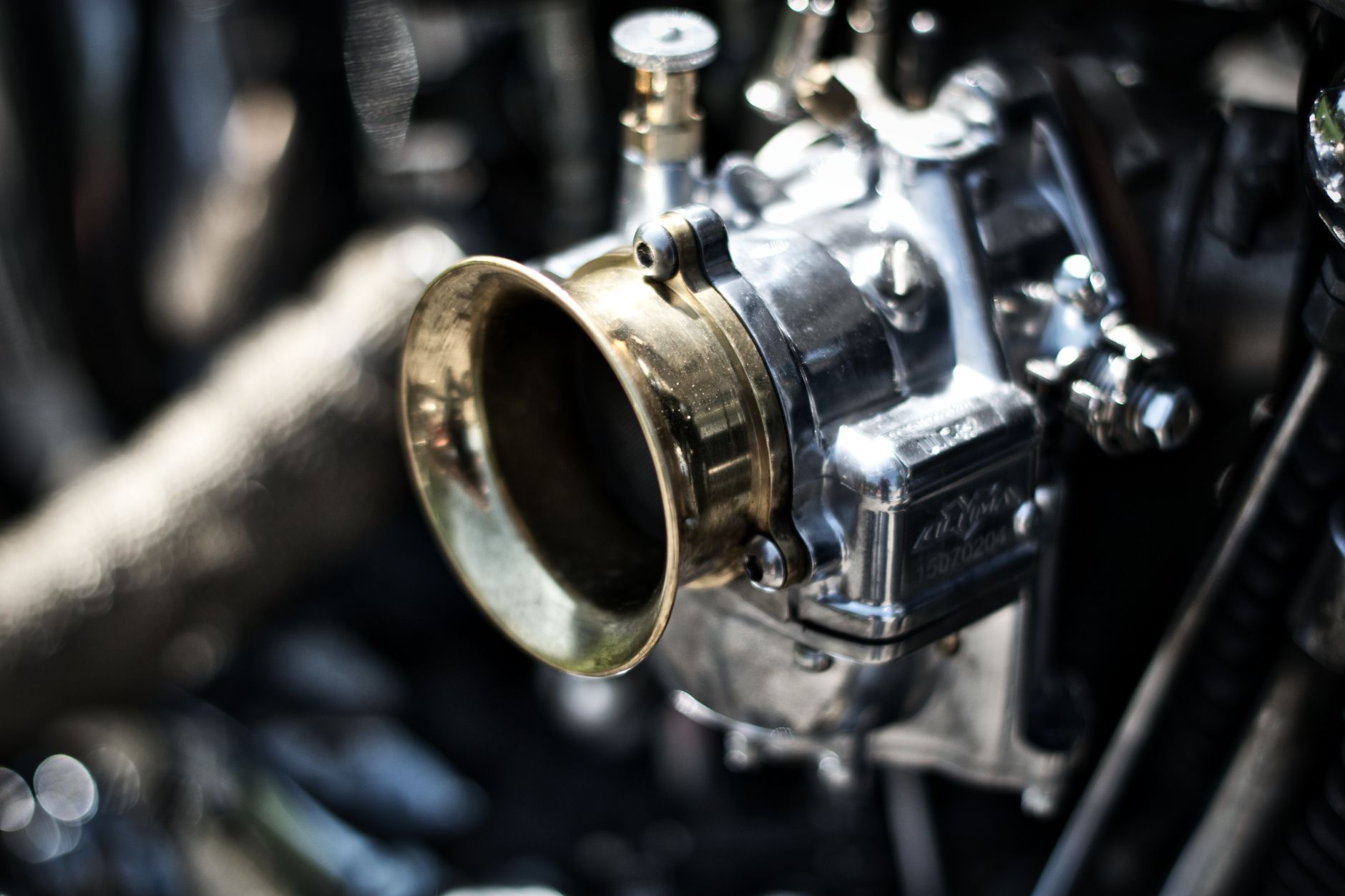
The valves orchestrate the entry and exit of gases in the cylinders. Between the camshaft and the valves, a millimetric clearance allows for thermal expansion. Too tight, the valve no longer closes properly and burns. Too wide, the engine rattles, loses performance and wears prematurely. This check is not optional.
Why valve clearances go out of adjustment
Valve seats gradually sink into the cylinder head under the effect of millions of opening and closing cycles. Each time a valve slams onto its seat, it sinks by a few microns. The metal works at 800°C on the exhaust side. Tappet buckets or followers also wear in contact with the adjustment shims.
On an engine running at 6000 rpm at steady speed, each valve opens and closes 50 times per second. After 12,000 km, we're talking about several hundred million cycles. Wear is inevitable.
Clearances mostly tighten. An intake that goes from 0.15 mm to 0.08 mm loses effective lift. An exhaust at 0.05 mm remains half-open when hot and compression leaks. I've seen burnt exhaust valves in 5000 km on a Kawasaki ER-6 never checked after 35,000 km. The engine lost 20% power and consumed oil.
Check intervals according to manufacturers
Recommendations vary enormously depending on engine architecture and each brand's commercial strategy.
Common intervals:
- Yamaha MT-07, MT-09: 42,000 km (twin-cylinder engine, tolerant architecture)
- Honda CB500F, CBR500R: 38,400 km (robust parallel twin)
- Kawasaki Z650, Ninja 650: 24,000 km (parallel twin, tighter clearances)
- Suzuki GSX-S750: 24,000 km (four cylinder, 12 valves to check)
- Triumph Street Triple 765: 19,000 km (high-performance three cylinder)
- BMW S1000RR: 18,000 km (four cylinder high revving, 14,000 rpm max)
- KTM 390 Duke: 15,000 km (single cylinder, significant vibrations)
- Ducati Panigale V2: 24,000 km (desmo, closing clearance check)
Singles and V-twins with large pistons require more frequent checks. Mechanical stresses are higher. A KTM 690 Duke requires a check every 15,000 km. Its large 102 mm piston generates significant inertia.
Conversely, modern Japanese parallel twins (Yamaha's CP2, Honda's 471 cc engine) run smoothly and easily last 40,000 km without significant drift. I've checked MT-07s at 50,000 km with clearances still within tolerances.
"A valve clearance outside tolerance can destroy an engine in a few thousand kilometers. It's the most critical maintenance after an oil change." — Yamaha workshop manual, maintenance section
Checking method with feeler gauges
The check is done with a cold engine, after a minimum of 3 hours stopped. Manufacturer values are understood at 20°C. A warm engine distorts measurements by several hundredths.
Standard procedure:
- Remove the tank and side covers to access the valve covers
- Remove the valve covers (10 N·m tightening torque on reassembly)
- Bring the cylinder to Top Dead Center (TDC) on compression using the gearbox output sprocket
- Both cylinder valves are closed, followers released
- Insert feeler gauges between cam and follower (or tappet depending on architecture)
The gauges should slide with slight resistance. Too much resistance: insufficient clearance. Too much freedom: excessive clearance. Proceed by successive trials with 0.02 mm blades in 0.02 mm increments until finding the right value.
Typical tolerances (cold engine):
| Valve type | Min clearance | Max clearance | Optimal |
|---|---|---|---|
| Intake | 0.10 mm | 0.20 mm | 0.15 mm |
| Exhaust | 0.20 mm | 0.30 mm | 0.25 mm |
These values correspond to the majority of recent Japanese four-strokes. Exhausts require more clearance because they heat up more and expand more.
On a four cylinder, we check 16 valves. The crankshaft makes two complete revolutions (720°) per cycle. Each cylinder is successively positioned at TDC compression. Timing marks on the alternator or gearbox output sprocket facilitate positioning.
Pro tip: Once cylinder 1 is at TDC, note which cams are at their low point (lobe pointing outward). These are the valves we measure. Then turn the crankshaft 180° for the next cylinder on a four cylinder.

