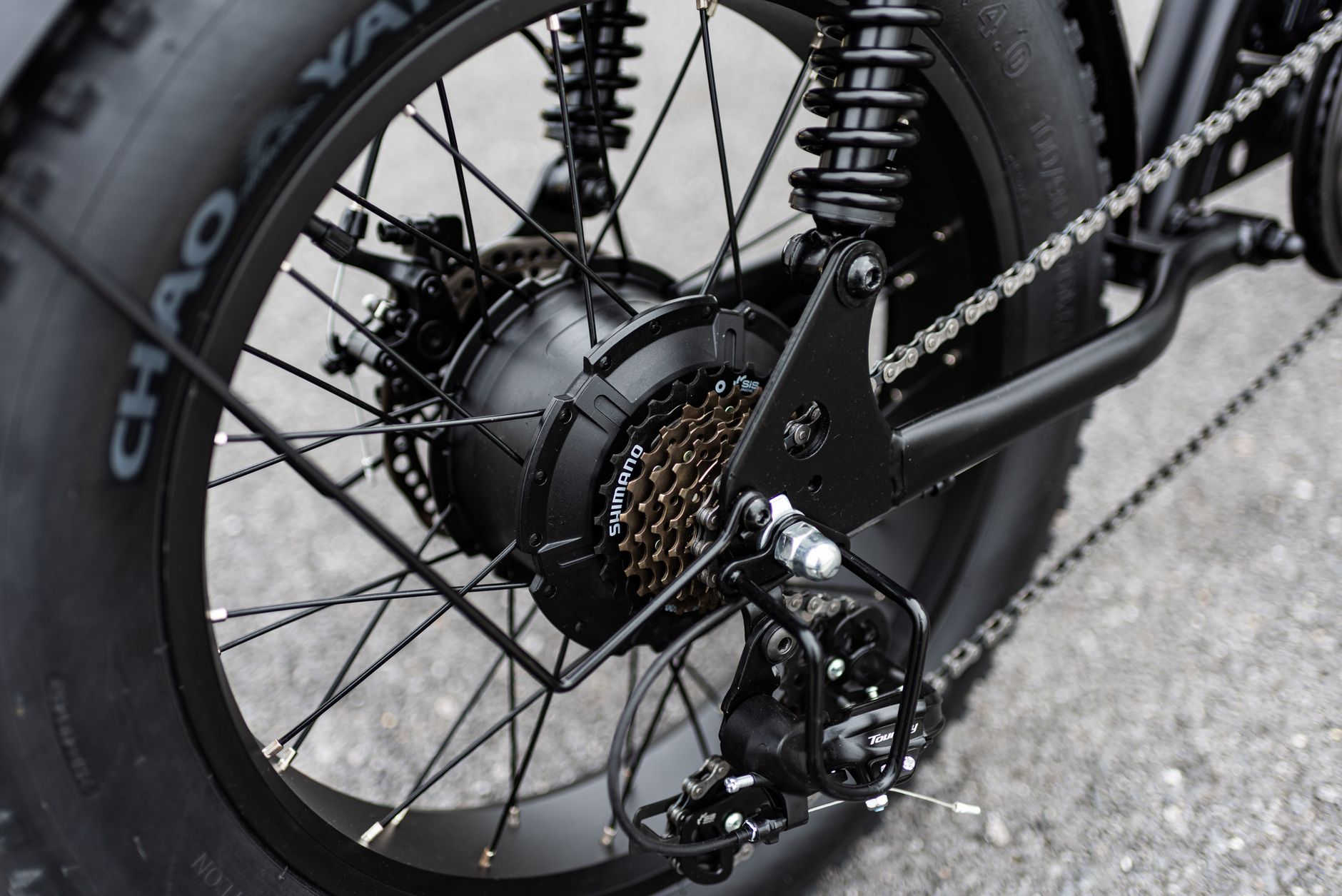
The vast majority of budget Chinese e-bikes have their motor in the hub of the rear wheel, sometimes the front. On the casing you sometimes read a name: Aikema, Bafang, MXUS, Dapu, Ananda, or more and more often nothing at all. Good news: whatever the maker, a hub motor is diagnosed the same way, because it is built the same way. Three sensors, three phases, and on many models a gear reduction.
First: who makes what
- Aikema: a motor maker based in Suzhou, which claims to have been founded in 1986 and produces hub motors, mid-drives, controllers and displays. Its small geared motors (the Q100H and Q128H are examples well known to home builders) power many kits and e-bikes.
- Bafang: best known for its mid-drives, it also makes hub motors. Its systems' codes are in our article on Bafang error codes.
- MXUS, Dapu, Ananda: other big Chinese hub-motor suppliers, found on bikes of every brand.
- Gobao: the name gets around, and the brand does exist. It is a Chinese motor maker supplying bike manufacturers (OEM); according to the company, more than twenty years in business and around 1,500 employees. In 2026 it is mostly talked about for a mid-drive, the X1P, shown at Eurobike with a built-in continuously variable transmission (150 Nm, 1,500 W peak), with series production announced for February 2027. We found no public documentation (code table, workshop manual) for Gobao hub motors. If your casing carries that name, the method below applies as is.
Above all, remember this: the motor does not talk. Error codes come from the controller and appear on the screen. To read them, see our articles on Chinese displays and KT controllers. Here we deal with what the code points to: the motor itself.
Geared or direct drive?
| Geared motor | Direct-drive motor | |
|---|---|---|
| Where | City e-bikes, folders, most budget e-bikes | Powerful fat bikes, some cargo bikes, high-power kits |
| Weight | Light | Heavy |
| Freewheel | Yes, built in: the wheel spins freely with the motor off | No: you feel slight magnetic drag pushing the bike |
| Wear part | Planetary gears (often nylon), internal freewheel | Few: bearings, cable |
| Regenerative braking | Impossible | Possible if the controller supports it |
This table changes the diagnosis: a geared motor that "spins but drives nothing" almost always has an internal mechanical problem; a direct-drive motor almost never.
Symptoms, and what they point to
| Symptom | Most likely cause | Test |
|---|---|---|
| Hall code (03 on KT, 24 or E003 elsewhere), jerky start | Hall connector, Hall wire, Hall sensor | Hall test (below) |
| Motor judders, vibrates, draws a lot, runs hot | Open phase or failing Hall | Phase test, then Halls |
| Short-circuit code (06 on KT, 21 elsewhere) | Phases touching each other or the axle | Insulation test |
| Motor runs (you can hear it) but the bike does not move | Worn planetary gears or slipping internal freewheel | Opening the motor |
| Clack at every wheel turn | Stripped gear, bearing, loose magnet | Opening the motor |
| Nothing at all, screen on | Motor connector unplugged, controller | Connectors, then controller |
| Axle spinning in the dropout, cable torn out | Start-up torque without a torque arm | Stop immediately, see safety |
Tools
A multimeter costing a few tens of pounds is enough (we explain the basic measurements in the 6 multimeter measurements). Add fine probes or needles to back-probe the connectors, and that is it for the electrical side. To open a geared motor, you also need whatever removes the side cover (screws, sometimes a puller) and patience.
Testing the Hall sensors
The three Hall sensors tell the controller where the rotor is. They connect through a small 5-wire connector (sometimes 6 with a temperature sensor): red (supply, about 5 V), black (ground), and three signals, usually yellow, green, blue.
- Controller powered, Hall connector plugged in, back-probe the connector.
- First check about 5 V between red and black. If there is nothing, the problem is on the controller or cable side, not the sensors.
- Then measure between black and each signal while turning the wheel slowly by hand (in the riding direction for a geared motor, which otherwise just freewheels). Each signal should alternate between about 0 V and about 5 V.
- A signal stuck at 0 V or 5 V: dead sensor or cut wire. A signal that only reaches half voltage: dubious sensor.
The sensors can be replaced (they are standard components soldered into the stator), but it means opening the motor and soldering cleanly. Many owners prefer to replace the whole motor.