Riding in winter isn't the same as in summer. Below 7°C, standard tires already lose grip. At -5°C, you reach the reasonable limit for riding a motorcycle, unless you have appropriate equipment and preparation. I've spent fifteen winters maintaining motorcycles that went out in all weather conditions, and I'm going to explain how to prepare your machine and your gear for riding when the thermometer drops.
The tire question in cold weather
Sport and standard road tires use compounds that harden below 7°C. Below this temperature, grip drops by 30 to 40%, especially during the first kilometers before friction warms them up a bit.
Heidenau Snowtex remain the only true winter tires approved for motorcycles. Available in K66 (road) and K58 Mod (trail), they use a compound that maintains its flexibility down to -10°C. Expect to pay around €180 for a set in 120/70-17 and 170/60-17 sizes. Their tread pattern includes fine sipes that evacuate water and maintain contact on light ice. However, they wear 20% faster than standard tires on dry asphalt.
For those who ride less than 2000 km in winter, Michelin Pilot Road 5 or Continental ContiRoadAttack 3 in touring compound do the job down to 2-3°C. Their silica compound maintains a certain flexibility, even though it's still a compromise. The difference in behavior between 15°C and 2°C is significant: you need to anticipate more in corners and limit lean angle.
Tire pressure: increase by 0.1 bar compared to manufacturer recommendations. Air contracts with cold (approximately 0.1 bar per 10°C drop). On an MT-07, this means 2.6 bar front and 3.0 bar rear instead of 2.5/2.9 bar.
"In extreme cold, tires easily take 10 km before reaching their operating temperature. The first three corners are critical." – Yamaha Tracer 9 GT owner's manual, winter riding section
Rider equipment: the three-layer technique
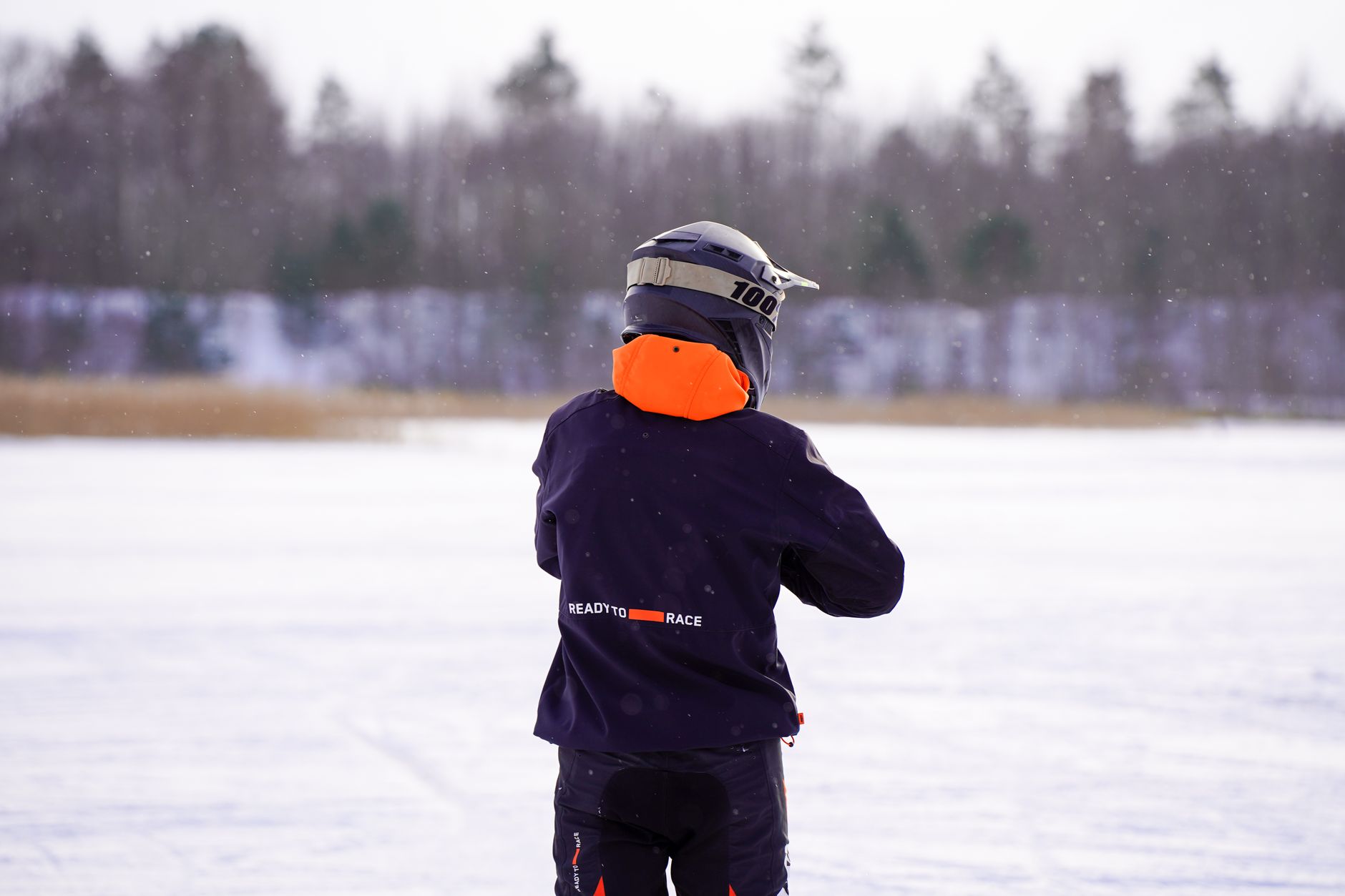
Hypothermia begins when body temperature drops below 35°C. At 90 km/h in 0°C conditions, wind chill is equivalent to -15°C felt temperature. Without appropriate equipment, a 30-minute journey is enough to lose alertness.
Three-layer system mandatory:
- Layer 1 (thermal): technical underwear like Damart Thermolactyl or X-Bionic. They wick away perspiration while insulating. Budget €60-80 for top+bottom.
- Layer 2 (insulating): 200g/m² fleece or thin down jacket. It traps air warmed by the body. Budget €40-60.
- Layer 3 (protection): motorcycle jacket with waterproof/breathable membrane. Gore-Tex or equivalent essential.
Heated grips become necessary below 5°C. Oxford Heaterz Premium (€85) or Daytona Heated Grips (€110) models provide 30-40W per grip. They connect directly to the battery with a 10A fuse. On a 12Ah battery, they draw approximately 6Ah at max setting – check that your alternator charges at least 15A at idle.
Installation in 45 minutes: disconnect the battery, remove old grips (cut them off if glued), degrease the handlebar with acetone, glue new ones with specific adhesive (supplied), connect to battery with supplied wiring harness running under the tank. Test the three heat settings before reassembling everything.
Anti-fog visor: Pinlock systems work like double glazing. The inner lens, fixed by silicone pins, creates an insulating air gap. A Pinlock MaxVision costs €30-40 depending on helmet brand. Lifespan: 2-3 years before the silicone loses its seal. Clean only with warm water and microfiber, never chemical products.
Anti-fog sprays (FogCity, €12) work for 2-3 weeks but leave a greasy film. Skip them if you have a Pinlock.
Mechanical preparation of the motorcycle
Engine oil
Oil thickens with cold. A 10W-40 becomes pasty below 0°C, the starter struggles and lubrication at startup is insufficient for 30 seconds. Switch to 5W-40 as soon as morning temperatures drop below 5°C.
On a four-cylinder like a Kawasaki Z900, the difference at startup is audible: the engine spins 200-300 rpm faster instantly with 5W-40. The oil change costs €50-60 with filter (Motul 7100 or Castrol Power1 Racing). Take the opportunity to check the drain plug torque: 25-30 N·m depending on model.
For touring big bikes (BMW GS, Yamaha Super Ténéré), some even run 0W-40 in winter. Smoother starts, but check compatibility in the technical manual.
Fuel and intake system
Gasoline always contains some water from condensation. With freezing, this water turns into crystals that can clog the fuel filter or jets (on carburetors). Two precautions:
Stabilizer additive: Ipone Fuel Stabilizer or equivalent (€10 for 250ml bottle for 50 liters). Dose: 5ml per liter. It emulsifies water and cleans the circuit. Add at each fill-up in winter.
Tank always full: limit condensation by keeping the tank at least 3/4 full. A 17-liter tank half empty contains 8-9 liters of air that loads with moisture.
On carburetors (older bikes), jets can clog. Symptoms: difficult starts, hesitation on acceleration. Clean them preventively in November with 0.3mm brass wire and carb cleaner.
Battery
At 0°C, a battery loses 35% of its capacity. At -10°C, it's 50%. A 10Ah battery only provides 5Ah. The starter draws 100-150A for 2-3 seconds: do the math.
Battery maintainer essential if you don't ride daily. CTEK MXS 5.0 (€70) or Noco Genius 5 (€75) models maintain charge without overcurrent. Connect them directly to the battery via terminals (bike in garage).
Simple battery test: headlight on with engine off, voltage must stay above 12.4V for 30 seconds. Below that, the battery is weak. A new AGM battery costs €80-140 depending on capacity (10-14Ah).
Coolant
The antifreeze ratio must be at least 50% to protect down to -35°C. Check with a refractometer (€20 online): take a few drops, place on the lens, read the protection temperature. If it's marginal, drain the system (5-6 liters depending on bike) and refill with fresh coolant already mixed 50/50.
Recommended coolant: Motul Motocool Expert -37°C (€25 for 5 liters) or equivalent meeting Japanese standard JIS K2234. Bleed air by opening the bleed screw (often on the water pump) with engine warm, until liquid flows without bubbles.