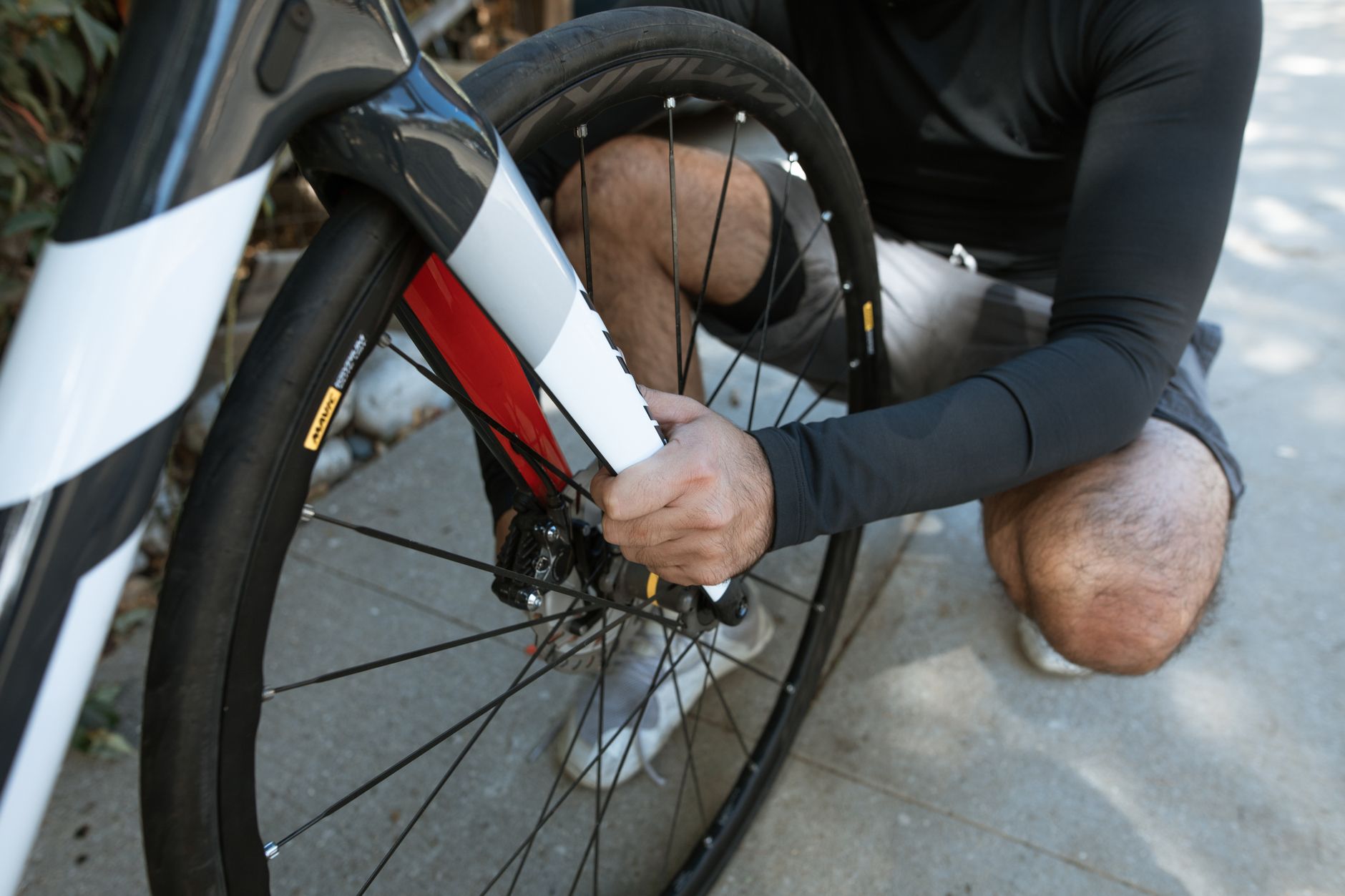
A steel fork bends before it breaks — you get a warning. A carbon fork can look perfectly intact yet have suffered structural damage invisible to the naked eye. That's what makes regular inspection absolutely critical on carbon components.
Carbon is a composite: carbon fibers embedded in epoxy resin. Strength comes from fiber orientation (layup). An impact can break fibers or delaminate resin layers without the outer surface showing much.
Visual inspection — the foundation
Perform this inspection at least once a month, and systematically after any impact (crash, collision, curb strike).
Critical zones:
Base of the steerer tube: this is the maximum stress zone. Look for cracks, paint chips, or unusual lines
Junction between fork blades and crown: carefully examine the joints between the fork tubes and the upper section
Dropouts: check the carbon integrity around metal inserts
Blade surfaces: run your hand slowly along the full length. You're feeling for bumps, dents, soft spots, or texture variations
What's serious:
Visible crack in the carbon (even hairline, even under clear coat) → replace
Soft spot to the touch (healthy carbon is hard and resonant) → replace
Whitish discoloration around an impact zone → possible delamination → professional inspection
Deep chip that has penetrated through the gelcoat to the fibers → professional inspection
What's cosmetic:
Small surface scratches in the clear coat
Paint chips that don't penetrate the fibers
Cable rub marks
The tap test — its limitations
The "coin tap test" involves tapping the fork with a coin and listening. Healthy carbon produces a clear, sharp sound. Damaged carbon produces a dull or dead sound.
Caution: this test is a first indicator, not a diagnosis. It doesn't detect all types of damage, particularly deep delaminations. It can also give false positives in areas of variable thickness (crown, junctions). Don't use it as your sole decision criterion — it's a complement to visual inspection.
Steerer tube — the critical point
The steerer tube is the most critical component of the fork. It connects the fork to the frame through the headset. Assembly errors here can be catastrophic.
Torque specs:
Top cap bolt: 1-2 Nm — this only preloads the bearings, NOT to clamp the fork
Stem clamp bolts: 5-6 Nm — THIS is the clamping that holds the fork. Tighten in a star pattern with progressive passes
NEVER exceed 6 Nm on stem bolts with a carbon steerer. Carbon crushes under excessive pressure
Star nut vs compression plug:
Star nut: hammered into the steerer. Standard on alloy steerers. Forbidden on carbon — hammering can crack the tube
Compression plug (expander plug): the standard for carbon steerers. It tightens from the inside and exerts controlled radial pressure. Most common: Cane Creek or FSA. Expansion bolt torque: 5-6 Nm
Absolute rule: the top of the carbon steerer must sit 3 to 5 mm below the top edge of the stem. If the steerer is flush with or above the stem, the stem clamps on nothing and the steerer will fail.
When to replace a carbon fork
The lifespan of a carbon fork depends on usage, but here are the warning signs:
Any visible crack, even small → immediate replacement
After an accident with frontal impact → mandatory professional inspection
Abnormal play in the headset despite correct adjustment → check the steerer
Dull sound on tap test in an area that was previously clear → professional inspection
After 10 years of intensive use (racing, gravel, loaded touring) → ultrasound inspection recommended
Professional ultrasound inspection
Specialized workshops use ultrasonic sensors to detect invisible internal delaminations. Cost is 50 to 150 € depending on complexity. It's an investment worth making if you have doubts after a crash, especially on a high-end fork costing 300 to 600 €.
L'Atelier can help you identify the exact model of your fork and the manufacturer's recommended torque specs. Ask your question directly.
On utilise des cookies essentiels au fonctionnement. Avec ton accord, on ajoute la mesure d'audience et l'attribution de nos liens/sondages partenaires (ça finance le service). En savoir plus