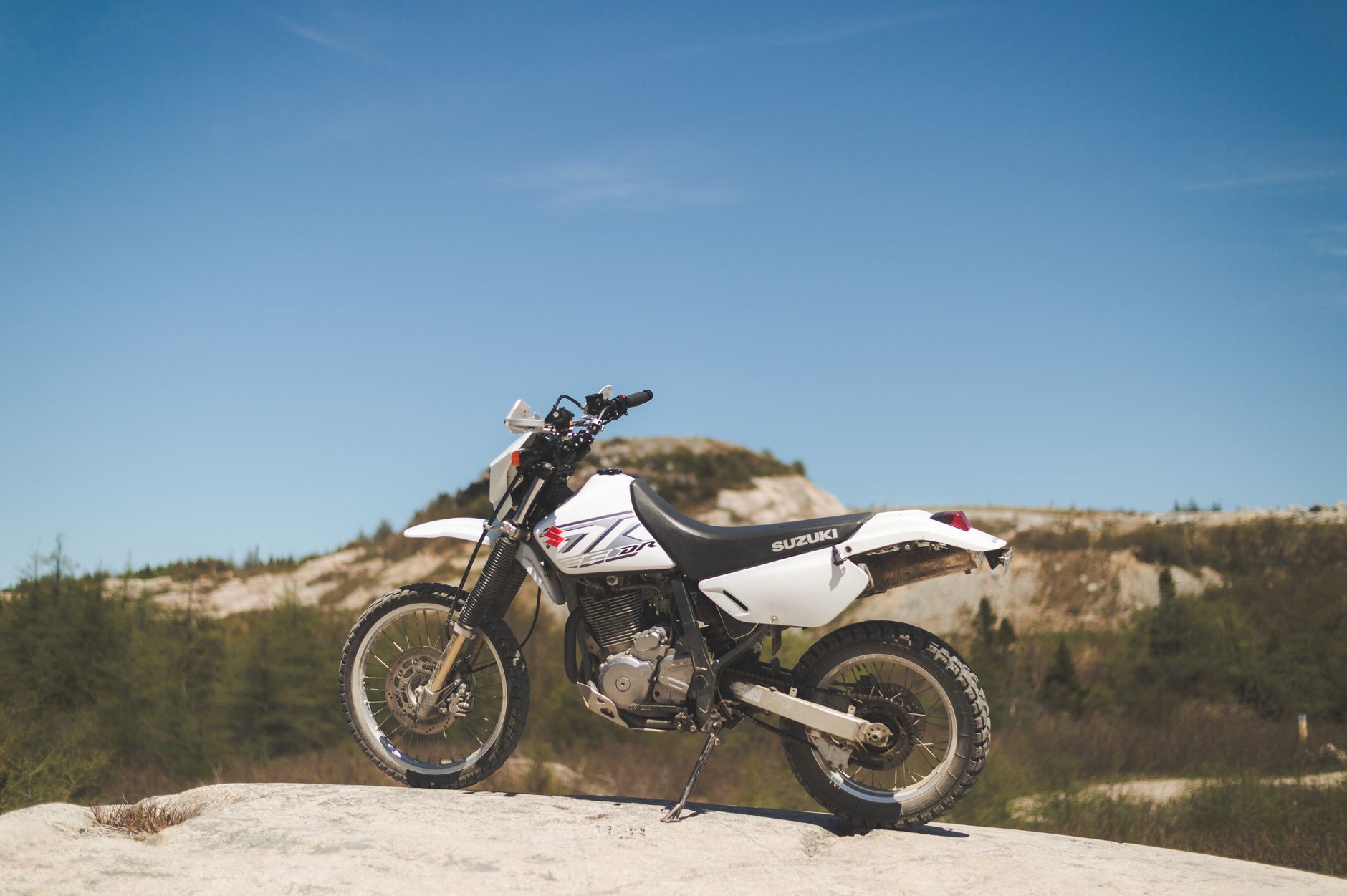
The DR 650 SE remains a special case in the road-trail landscape. This Japanese single-cylinder has crossed the decades without a wrinkle, with a reputation for reliability that attracts beginners and high-mileage riders alike. But between its dated design and the often-necessary modifications, should you still bet on this machine used today?
An indestructible single with ancient roots
The DR 650's engine block dates back to 1990, and that's probably the most common argument in debates. This 644 cc SOHC single develops 44 horsepower at 6,400 rpm for a torque of 54 N·m at 5,200 rpm. On paper, nothing exciting. In practice, this tractor-simple engine eats up kilometers without flinching.
The liquid-cooled four-valve architecture displays exemplary fuel economy: between 4.2 and 4.8 L/100 km depending on riding style. The 40 mm BSR carburetor may surprise in the age of fuel injection, but it guarantees accessible repairs, even in the middle of nowhere.
The complete transmission comes down to five well-spaced gears, a 520 chain, and a wet clutch that handles everything without failing. Maintenance remains biblically simple: oil change every 6,000 km with 2.6 liters of 10W40 oil, regular chain adjustment, and air filter replacement every 10,000 km. Valve clearance is checked every 24,000 km, an operation doable at home with a feeler gauge and a good manual.
"The DR 650 is the bike you fix with a hammer and pliers at the side of the trail, and it still starts."
This reputation for robustness is verified on used models with more than 50,000 km on the clock. Mechanical failures remain rare: alternator that gives up around 60,000 km (Electrosport part at €180), voltage regulator that burns out (€90 aftermarket), or capricious automatic choke (bypassable with a manual kit at €45).
The limitations of the original chassis
Where the shoe pinches is at the chassis level. Suzuki kept a budget front suspension: conventional 43 mm fork with no adjustment, 250 mm travel that sorely lacks support as soon as you load the machine or ride fast on poor surfaces.
The rear mono-shock absorber displays the same compromises, with a spring undersized for a rider over 80 kg with gear. On the road, comfort remains acceptable up to 110 km/h. Beyond that, oscillations amplify and steering becomes vague.
The brakes contribute to the rustic side: single 280 mm front disc gripped by a single-piston caliper, 160 mm rear drum. ABS obviously doesn't exist. Braking requires anticipation, especially with loaded panniers.
The 13-liter tank constitutes the other black mark. With a real range of 260 to 280 km, long-distance trips require additional jerrycans. Several manufacturers offer replacement tanks:
- IMS 22 liters: €389, pannier-compatible, +9 kg
- Safari 28 liters: €520, bulky but 600 km range
- Acerbis 20 liters: €295, good weight/capacity compromise
The almost mandatory modifications
Few owners keep their DR completely stock. Some adjustments truly transform the machine's behavior.
Front suspension: Pro Cycle progressive springs (€240) radically change handling. Fork oil goes to 15W viscosity (2x375 ml) instead of the original 10W. Operation doable in two hours with PVC tubes to hold the fork tubes during draining.
Rear shock: the Hyperpro with adjustable spring (€420) or the Works Performance (€680) restore comfort and precision. The investment is justified from 15,000 km/year.
Engine protection: essential. The SW-Motech skid plate (€165) or Happy Trail (€195) avoid disaster on a hole or rock. The alternator cover has no original protection, and an impact easily punctures it.
Comfort seat: after 150 km, the stock seat becomes a bed of nails. Seat Concepts (€285) or Sargent (€390) options are worth every euro invested for long-distance trips.
Exhaust: the stock silencer weighs 6.8 kg. A SuperTrapp (€240) or Big Gun (€320) lighten by 3 kg and free up 2-3 horsepower. The carburetor then requires tuning: main jet goes from 145 to 150, needle one notch higher.
Electrical: generator power remains limited to 280 W. With LED headlights (consumption divided by three), you can plug in a USB port and auxiliary lights without overloading the circuit.