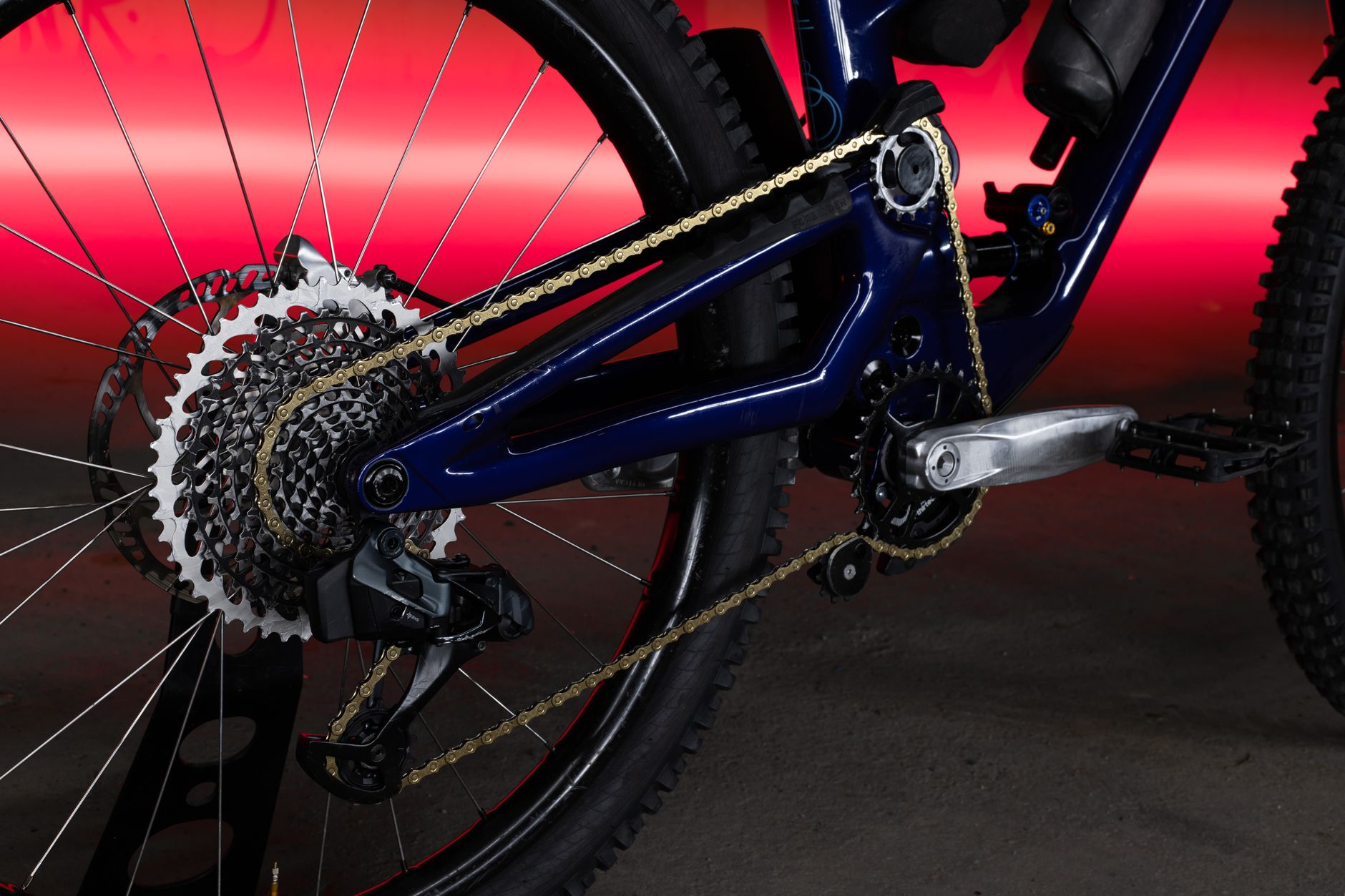
The 1x drivetrain (pronounced "one-by") has revolutionised bike transmissions, especially in mountain biking. The principle: a single chainring up front, no front derailleur, and a wide-range rear cassette to compensate.
The benefits
Simplicity: one fewer shifter on the bar, one fewer cable, one fewer derailleur. Fewer parts = fewer breakdowns
Weight: save 200-400 g (front derailleur + cable + second chainring + shifter)
Chain line: straighter on average, less friction, less wear
No chain drops: with a narrow-wide chainring and a clutch derailleur, the chain stays put
Ground clearance: without the front derailleur, no risk of catching on rocks
The downsides
Reduced gear range: even with a 10-52T cassette, the range is less than a 36/26 double with an 11-42T cassette
Gear jumps: gaps between sprockets are larger (e.g., 10-12-14-16-18-21-24-28-33-39-45-52T). With 2x, the steps are more even
Price: wide-range cassettes are expensive (100-300 EUR for a SRAM Eagle or Shimano XTR 12-speed)
Choosing chainring size
The chainring choice depends on your riding and terrain:
Riding style
Recommended chainring
Typical cassette
XC race
32T-34T
10-51T or 10-52T
Trail
30T-32T
10-51T or 10-52T
Enduro
28T-32T
10-52T
Gravel
38T-42T
10-44T or 10-51T
Road (1x)
40T-44T
10-36T or 10-42T
Simple rule: if you are walking uphills with your current chainring, go 2 teeth smaller. If you are spinning out on descents, go 2 teeth larger.
Narrow-wide teeth
A 1x chainring uses narrow-wide (alternating) teeth: one wide tooth, one narrow tooth, matching the outer and inner chain links. This is what prevents chain drops without a chain guide.
Compatibility notes:
The BCD (Bolt Circle Diameter) must match your crankset: 104 mm (old standard), 96 mm (Shimano Asymmetric), Direct Mount (SRAM, Shimano)
Speed count: 12-speed chainrings have a slightly different tooth profile from 11-speed. Most work with both, but check
Freehub body: XD (SRAM proprietary). Incompatible with Shimano HG bodies.
Shimano 12-speed
CS-M6100 (Deore): 10-51T, ~550 g, ~50 EUR — excellent value
CS-M7100 (SLX): 10-51T, ~485 g, ~70 EUR
CS-M8100 (XT): 10-51T or 10-45T, ~380 g, ~80 EUR
CS-M9100 (XTR): 10-51T or 10-45T, ~340 g, ~250 EUR
Freehub body: Micro Spline (Shimano 12-speed). Incompatible with standard HG (10/11-speed) and XD (SRAM) bodies.
Freehub body compatibility
Cassette
Required body
HG compatible?
SRAM Eagle 12-speed
XD
No
Shimano 12-speed
Micro Spline
No
Shimano 10/11-speed
HG
Yes
SRAM 10/11-speed
HG
Yes
Rear derailleur setup
With a 1x drivetrain, the rear derailleur does ALL the work. The setup must be perfect.
Clutch derailleur
All modern 1x rear derailleurs have a clutch: a friction mechanism that prevents the chain from bouncing. The clutch must be engaged (lever ON). If the chain slaps on descents, check that the clutch is working — if worn, the derailleur needs replacing.
B-tension adjustment
B-tension (or gap) controls the distance between the guide pulley and the largest sprocket. This is critical with 50T+ cassettes.
SRAM Eagle: use the SRAM gap tool. The guide pulley should be approximately 17-20 mm from the 52T sprocket
Shimano 12-speed: the pulley-to-sprocket distance should be 10-12 mm on the largest sprocket (depending on the exact model)
If B-tension is too low, the derailleur hits the cassette on the large sprockets. Too high, and shifting becomes sluggish and imprecise.
High and low limit screws
High limit (H): limits the derailleur on the smallest sprocket. On a 1x, it must not go beyond to prevent the chain falling between the sprocket and frame
Low limit (L): limits the derailleur on the largest sprocket. Must be open enough to reach the 52T without strain, but no more
Cable tension
Put the chain on the smallest sprocket
Loosen the cable anchor bolt
Pull the cable by hand, tighten the bolt to 4-5 Nm
Shifting should be precise from small to large. Adjust with the barrel adjuster: 1/4 turn counter-clockwise if upshifting is poor, 1/4 clockwise if downshifting is poor
SRAM Eagle vs Shimano 12-speed
Criterion
SRAM Eagle
Shimano 12-speed
Cassette range
10-52T (520%)
10-51T (510%)
Freehub body
XD
Micro Spline
Shifting feel
Crisper, faster
Smoother, more progressive
Clutch
Roller bearing (durable)
Friction-based (adjustable)
Price (GX/SLX level)
~300 EUR group
~250 EUR group
Electronic
AXS (wireless)
Di2 (wired)
Both work perfectly well. The choice often comes down to personal preference and ecosystem (whether you already have an XD or Micro Spline freehub body).
To check the exact compatibility between your crankset, cassette, and derailleur, L'Atelier retrieves the compatibility tables from Shimano and SRAM documentation in seconds.
On utilise des cookies essentiels au fonctionnement. Avec ton accord, on ajoute la mesure d'audience et l'attribution de nos liens/sondages partenaires (ça finance le service). En savoir plus