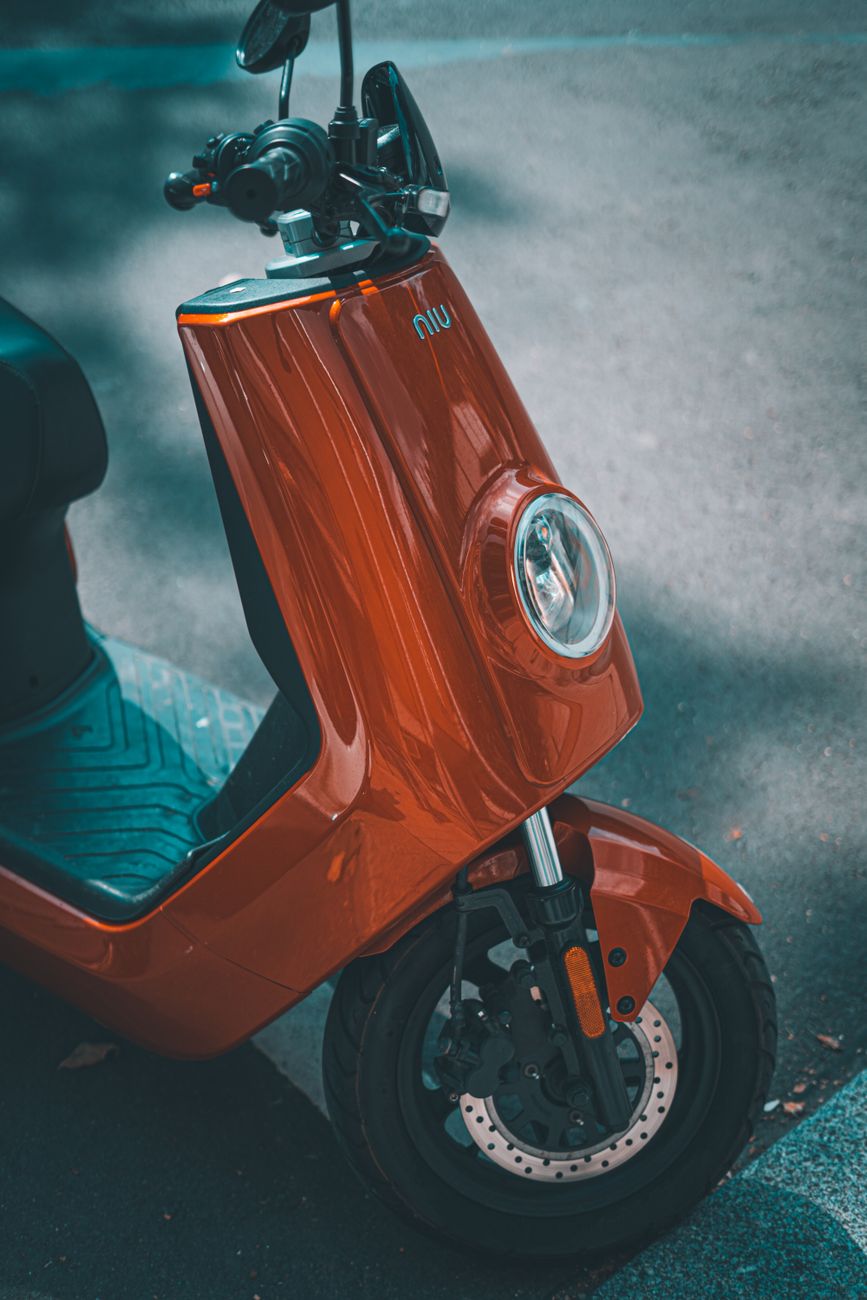
NIU was one of the first Chinese electric scooter brands to make it in Europe, with the N, M and U series, then the MQi GT and NQi. On all these models, a fault announces itself the same way: a number appears on the dash and, on recent models, the parking indicator flashes (it says so in the MQi GT manual). Good news: NIU publishes its code tables in its user manuals, and an importer has circulated a detailed version for workshops. We rely on those two sources.
NIU vocabulary in thirty seconds
The codes refer to four units. Knowing them already tells you where to look:
- ECU (the "smart central controller"): the scooter's brain, with the communication module, SIM card and GPS that feed the app.
- FOC: the motor controller (named after its control method, Field Oriented Control).
- BMS: each battery's management board.
- BCS: the unit that manages two batteries on dual-battery models.
Codes in the 1xx range mostly concern a failed component or one in protection mode, codes 30 to 82 charging and communication, codes 19x the links between units.
Codes you can sort out yourself
| Code | Meaning (NIU manuals) | Likely cause | What to do |
|---|---|---|---|
| 10 | Motor controller stopped: motor stuck | Wheel or motor jammed | Check nothing is blocking the wheel (brake, object, stand) |
| 11 | Under-voltage or over-voltage | Charger, battery | Check the charger is intact |
| 12 | Overcurrent | Current spike | Restart; see the dealer if it repeats |
| 13 | Controller overheat | Heavy load, heat | Park in the shade and let it cool |
| 22 / 23 | BCS too hot / too cold | Ambient temperature | Let it return to a normal temperature |
| 30 | Battery overcharge | Faulty or wrong charger | Switch on the headlight to discharge a little; check the charger |
| 31 | Charge overcurrent | Charger | Stop charging, check the charger |
| 32 | Charge protection (M series) | Cold battery: the manual cites over 30 s at 0 °C or over 3 s at −20 °C | Bring the battery indoors before charging |
| 80 / 81 / 82 | Fast charger in protection (temperature, voltage, current) | Fast charger | Unplug, let it cool, plug back in |
| 130 | Battery over-discharge | Battery almost empty, the BMS is about to protect itself | Stop riding and charge |
| 132 / 133 | Battery too hot / too cold | Temperature | Shade and rest; charge once back in the operating range |
| 67 | SIM card unpaid or weak signal | Connectivity subscription, no coverage | Does not stop a healthy scooter from riding; check the app subscription |
On dual-battery models, the same logic repeats as 50-51 and 150-158 for the second battery, and code 165 flags two mismatched batteries (different capacities or models).
Codes that need the dealer
| Code | Meaning | What the workshop does |
|---|---|---|
| 60 / 65 | Communication module fault / serial number not written | Reconnects the ECU, resets with the NIU diagnostic tool, otherwise replaces the ECU |
| 62 / 63 / 64 | GPS fault, GPS antenna shorted or open | Antenna and ECU |
| 99 | Communication harness fault | ECU or main harness |
| 110 | Motor controller fault (transistors or their driver) | Controller replacement |
| 111 | Controller verification failure (non-original controller or communication fault) | Restart first; otherwise controller or ECU |
| 120 | Motor fault: Hall sensor or motor cable unplugged | Motor connector, otherwise motor |
| 121 / 122 | BCS: damaged transistors / overcurrent | BCS replacement |
| 123 | Motor Hall signal failure | Motor |
| 134 | Battery no longer discharging (voltage difference between cells) | BMS and cell voltage check |
| 135 | Battery short circuit | Same, do not push your luck |
| 136 | Water ingress in the battery | Cell measurement: BMS or battery to replace |
| 138 | BMS transistors damaged | BMS replacement |
| 140 / 141 / 142 | Twist grip: Hall sensor, open circuit, short circuit | Connector, otherwise twist grip |
| 161 | Scooter remotely locked | ECU, alarm |
| 190 / 191 / 192 / 194 | Communication lost with the motor controller, battery 1, battery 2, the BCS | Connectors, then the unit concerned |
The list circulated to workshops states that several of these repairs go through the NIU diagnostic tool (an ECU reset after disconnecting its small internal backup battery). That is why, even with a good multimeter, an owner quickly goes round in circles on a 60 or a 111.
Two differences between the sources
- Codes 10 to 13 appear in the "workshop" list as a plain "controller fault", whereas the user manual details them (motor stuck, voltage, current, temperature). The manual is what helps the rider: a 13 in midsummer is fixed in the shade, not at the dealer.
- 32 is called "charge overcurrent" in the M series manual, but the cause given is cold. Trust the cause, and charge the battery at room temperature.
From one generation to the next, the tables are not strictly identical: some codes exist only on dual-battery models, others on connected models. NIU kick scooters (KQi) have their own numbering, not to be confused.