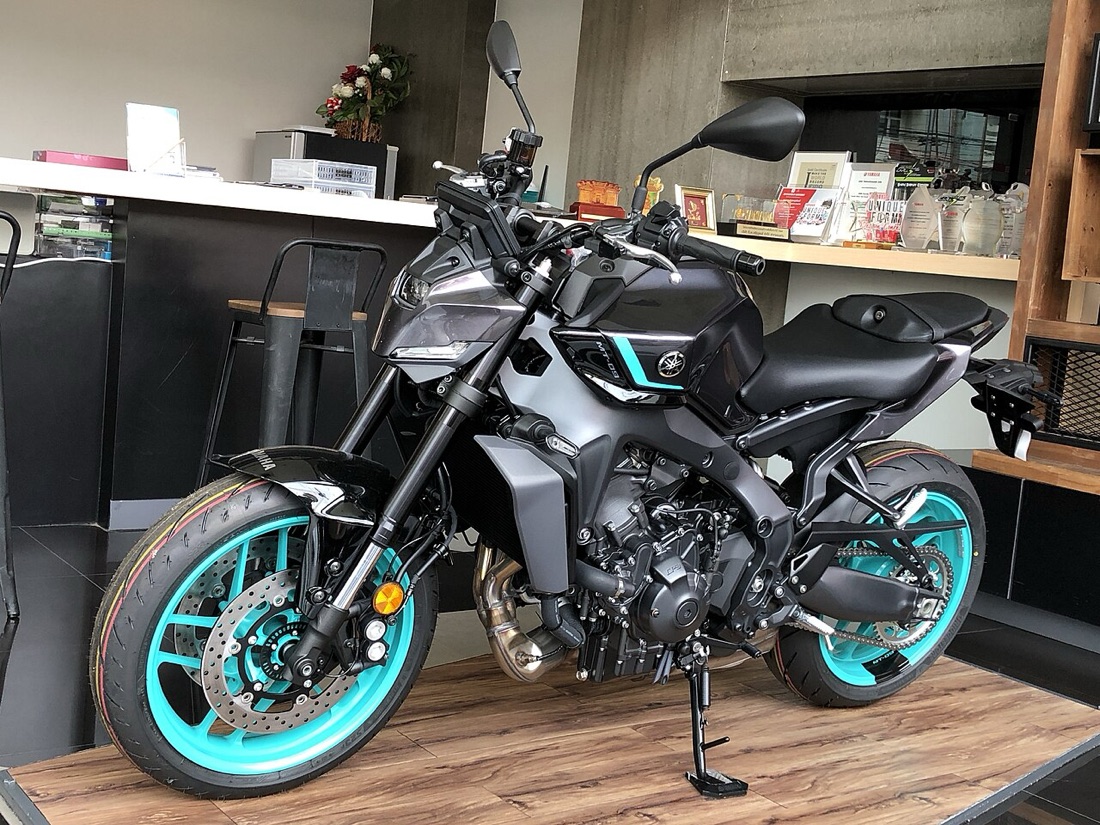

When you press the button and absolutely nothing happens, or you just hear a dry "click," the first reaction is often to think the starter motor is dead. Yet, in 70% of the cases I see in the workshop, the problem lies elsewhere. A methodical diagnosis avoids dismantling the engine for nothing and blowing €150-300 on a new starter that won't solve your problem.
A motorcycle's starting circuit involves about ten components between your hand and the starter itself. Each one can block the sequence. I'm going to show you how to test each element in logical order, from simplest to most complex.
The battery: prime suspect in 50% of cases
Before touching anything, get out your multimeter. A charged battery displays 12.6-12.8V at rest. Below 12.4V, it's starting to tire. At 12.0V, it no longer has enough juice to drive the starter, especially on a big twin or four-cylinder.
The static test isn't enough. Put your multimeter in voltmeter mode, connect it to the battery terminals and press the starter button. If the voltage drops below 10.5V during cranking, your battery is dead even if it shows 12.5V at rest. I've seen Kawasaki Z900s refuse to start with a battery holding 12.3V unloaded but collapsing to 8.2V under load.
Symptoms of a weak battery:
- Dashboard warning lights dim when you press
- You hear a single "click" or rapid "click-click-click"
- The starter turns sluggishly then stops
- It works after riding 30 minutes (alternator has recharged)
On recent models (BMW S1000RR, Yamaha MT-10, KTM Super Duke), the ECU even refuses to activate the relay if voltage drops below 11.8V. It's protection against undervoltage that could corrupt the fuel map.
Current test if you have a clamp meter: at startup, a 500-650cc draws 80-120A, a 1000-1200cc rises to 150-200A. If you measure less, either your battery is shot or the starter is slipping.
Fuses and relays: the silent culprits
The starter relay is a big black box generally located under the seat or near the battery. It's an electrically-controlled switch that sends the 150-200A needed to the starter. The starter button only controls 0.5A to activate this relay.
When you press the button, you should hear a solid "click" coming from the relay. If you hear nothing, three possibilities:
- The relay isn't receiving the command (button problem, kill switch, side stand switch or clutch switch)
- The relay is fried
- The main fuse is dead
Suzuki GSX-Rs and Bandits from the 2000-2010 years are known for relays that start clicking without turning. The internal contact welded then broke. A new relay costs €25-45 depending on model. Before buying, test it directly: disconnect it and jump the two large terminals with an insulated screwdriver (careful, it sparks). If the starter turns, the relay is dead.
For fuses, check the main one (often 30-40A) and the ignition circuit one (10-15A). A fuse can look intact visually but be blown. Test with multimeter in continuity mode.
"A starter relay doesn't warn you when it's going to fail. One day it clicks normally, the next day nothing. It's binary." – Honda CBR600RR 2007 workshop manual
Kill switch, side stand and clutch: the safety switches to check
All motorcycles since around 1995 have safety switches that prevent starting under certain conditions. These small switches, when dirty or misadjusted, are responsible for 20% of starting failures.
The kill switch: this red button on the right handlebar cuts ignition AND the starting circuit on most models. Remove it and clean the contacts with contact cleaner. Yamaha R6 and R1 2006-2014 have a recurring problem: the switch oxidizes and blocks the control even in "Run" position. Cost of a new right switchgear: €45-80.
The side stand switch: located on the side stand pivot, it prevents starting if the stand is down (except in neutral on some models). Test it with multimeter: it should show continuity with stand up, open circuit with stand down. Honda CB500, NC700 and Africa Twin have a switch that goes out of adjustment with vibrations. You can temporarily bypass it for testing, but be careful with use afterwards.
The clutch switch: on most sport and recent bikes, impossible to start without pulling the clutch. This switch screwed onto the perch gets dirty and no longer makes contact. Kawasaki ZX-6R 2009-2016 are champions for this problem. The switch costs €15-25, but often cleaning is enough.
Quick diagnostic method: bypass each switch one by one with a piece of wire. If the starter turns when you short-circuit a specific switch, you've got your culprit.