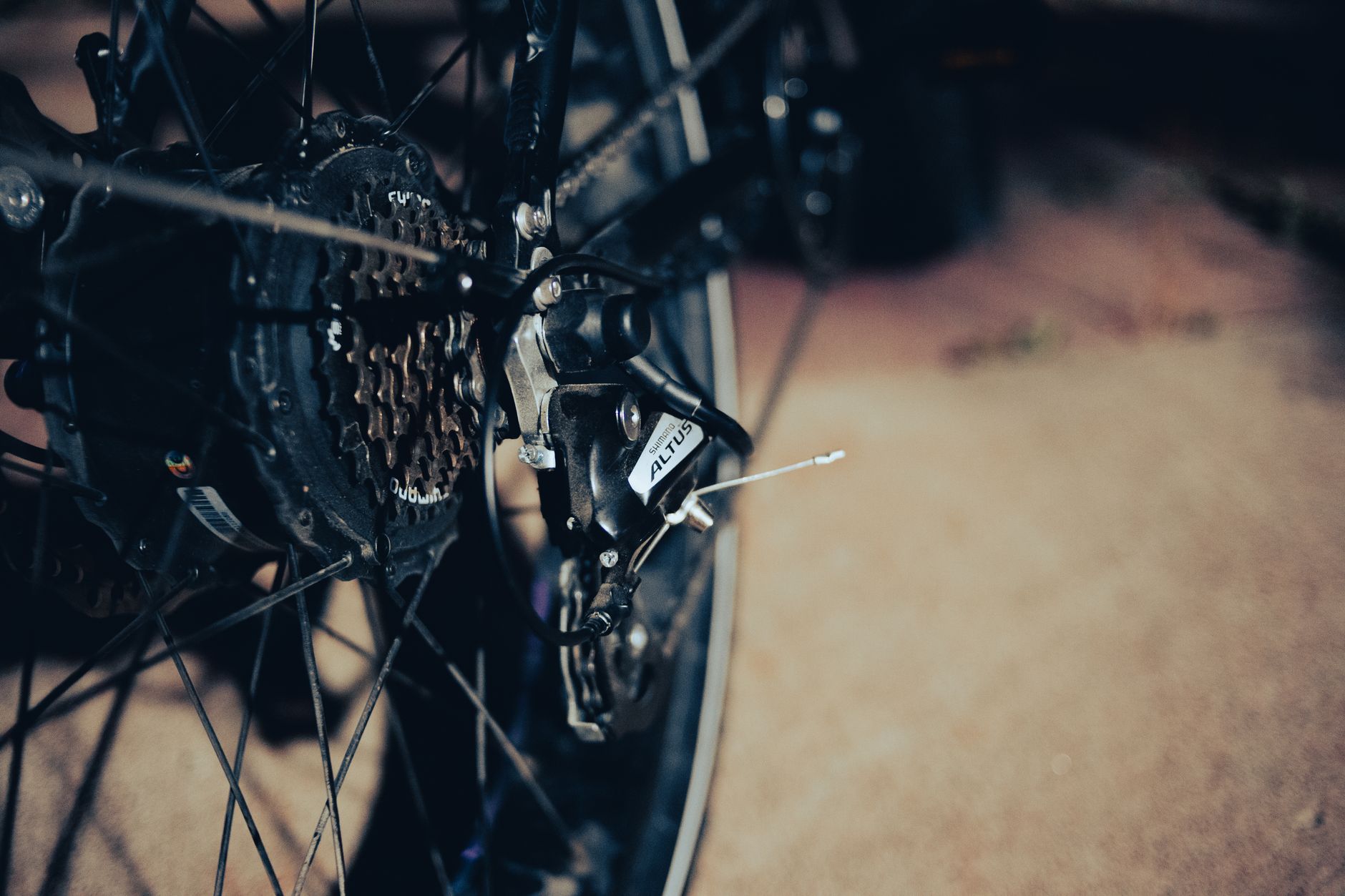
The rear derailleur has two small toothed wheels called jockey wheels (or "galets" in French). They're wear parts that are often overlooked, but they directly impact shifting quality.
Upper jockey wheel (guide pulley / G-pulley): the one closest to the cassette. It guides the chain to the correct cog. On recent Shimano derailleurs, it has intentional lateral play to assist shifting
Lower jockey wheel (tension pulley / T-pulley): it maintains chain tension. It spins freely and has no lateral play
When to replace them
Jockey wheels wear gradually. Here are the signs to watch for:
Pointed or shark-fin teeth: new teeth are symmetrical and rounded. If they become pointed or asymmetrical, they're done
Excessive lateral play: slight play on the guide pulley is normal (especially Shimano). But if you can move it more than 1-2 mm laterally, it's worn
Noise: a clicking or grinding sound that disappears when you stop pedaling often comes from the jockey wheels
Imprecise shifting: worn pulleys create slack in the chain, muddying the drivetrain so shifts don't snap cleanly
On average, jockey wheels last 10,000 to 15,000 km depending on conditions. In rain and mud (MTB, gravel), it's more like 5,000-8,000 km.
Ceramic vs steel bearings
Standard pulleys (steel/plastic): sealed steel bearings or plastic bushings. Price: 10-25 EUR. Reliable, easy to find, suitable for 95% of use cases.
Ceramic pulleys: hybrid ceramic bearings (ceramic balls, steel races). Price: 30-120 EUR. Known brands: CeramicSpeed, absoluteBLACK, Kogel. The friction reduction is measurable (0.5-2 W in testing) but only justifies the cost for racing.
Interesting aftermarket options:
absoluteBLACK Hollowcage: oversized pulleys with carbon cage, significant friction reduction
CeramicSpeed OSPW: top of the line, proven gains but high cost (300-500 EUR)
Anodized alloy pulleys: lightweight, durable, good value (20-40 EUR)
Step-by-step replacement
Tools needed: 3 mm Allen key (or 2.5 mm depending on the derailleur), possibly a screwdriver.
Note the orientation. Before disassembly, note the rotation direction. Most pulleys have an engraved arrow. The guide pulley rotates clockwise when viewed from the right side
Unscrew the lower (tension) pulley first. The bolt is typically a 3 mm Allen. Warning: the chain will go slack
Unscrew the upper (guide) pulley. The chain runs between the two cage plates — it will come free
Clean the derailleur cage. Take the opportunity to remove all accumulated grime between the plates
Install the new guide pulley respecting the arrow direction. Don't overtighten (1-2 Nm)
Thread the chain back through the cage and install the tension pulley
Check rotation: both pulleys should spin freely with no tight spots
Warning: on Shimano Shadow Plus derailleurs (with clutch), the guide pulley and tension pulley are NOT interchangeable. They have different diameters and bearings.
Use L'Atelier to identify compatible jockey wheels for your derailleur — give us the exact reference (e.g. RD-M8100) and we'll provide the specifications.
On utilise des cookies essentiels au fonctionnement. Avec ton accord, on ajoute la mesure d'audience et l'attribution de nos liens/sondages partenaires (ça finance le service). En savoir plus