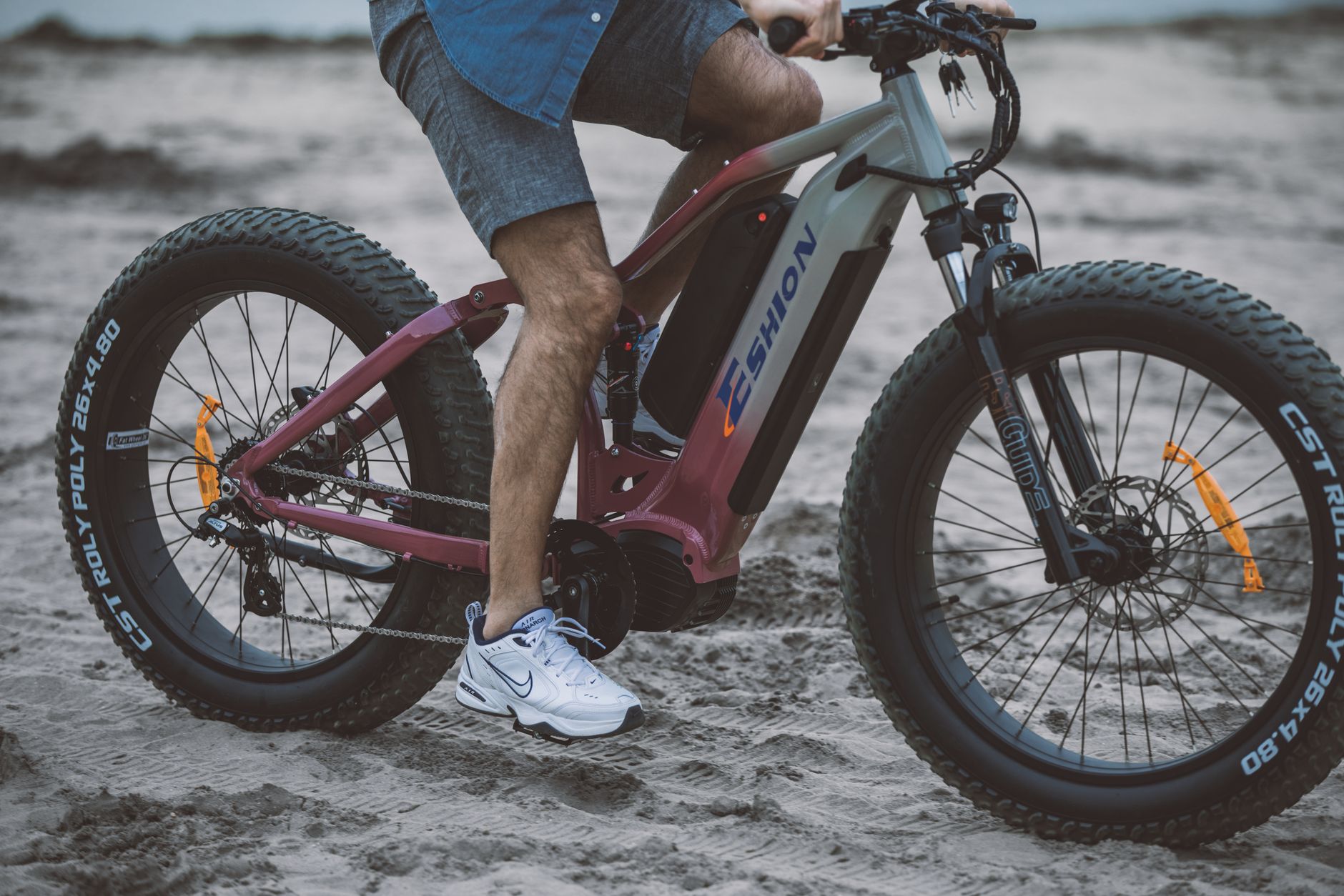
The electric fat bike has become the most policed object on French cycle lanes. In Paris, officers were given radar binoculars and a "speed bike" check was run on rue de Rivoli at the end of April 2026. In the Netherlands, seizures run into the thousands. And the French cycle industry estimates that 96% of fat bikes sold in France do not meet the legal definition of an electrically assisted bicycle.
Yet a fat bike isn't illegal in itself. Its electrical characteristics decide whether it's a bicycle or a moped. Here's how to tell, spec sheet in hand. (The rules are EU-wide in substance: the UK's EAPC regulations use the same 250 W / 15.5 mph limits.)
The rule: three conditions, all mandatory
The French Highway Code (article R311-1) defines the pedal-assisted cycle. To be a bicycle, your fat bike must tick all three boxes:
- A motor of 250 W maximum continuous rated power. Rated power is what counts, not battery capacity (Wh) or peak power.
- Assistance reduced then cut at 25 km/h. You can go faster on leg power, but the motor must stop.
- Assistance only when you pedal. The only exception is start or walk assist, allowed up to 6 km/h without pedalling.
If all three are met: it's a bicycle. No registration, no specific insurance (personal liability cover is enough), helmet compulsory only for under-12s, access to cycle lanes.
What turns your fat bike into a moped
French Service Public puts it like this: an e-bike whose motor is between 251 and 1,000 W, with assistance up to 25 km/h, falls into category L1e-A ("powered cycle"). Above 25 km/h of assistance and up to 45 km/h, it's an L1e-B, a moped just like a 50 cc scooter. And a bike whose assistance stays active above 25 km/h is a derestricted bike, banned from public roads.
The three cases we see most often on marketplace listings:
| What the listing says | Real status | Consequence |
|---|---|---|
| "250 W, 25 km/h, torque sensor, EN 15194" | Bicycle (EAPC) | Nothing to declare |
| "750 W" or "1,000 W", "top speed 25 km/h" | L1e-A moped | Registration, insurance, helmet, AM licence depending on age |
| Throttle working without pedalling above 6 km/h | Not a compliant e-bike | Same treatment as an L1e |
| "Off-road mode", "45 km/h", "unlockable" | L1e-B or derestricted | Not road-legal as sold |
Real examples from listings sold in Europe in October 2026: the Engwe X26/X24/X20 series states a 1,000 to 1,200 W motor "limited to 25 km/h", the Duotts C29 and F26 are listed at 750 W, the Samebike M20 at 1,000 W. A Fiido Titan test published in 2024 found a motor stated at 250 W rated but 750 W peak, and a throttle that didn't cut out at 6 km/h (it could be disabled in the app). Even the first Engwe EP-2 Pro, tested in 2021, was a 750 W throttle bike capable of more than 25 km/h: examples are still around on the used market.
The "peak power" trap
Brands play with words. The law talks about continuous rated power. A motor stated as "250 W rated, 500 W peak" is not illegal for that. A motor stated as "750 W" with no qualifier, however, should be read as 750 W rated. When in doubt, ask for the CE declaration of conformity and the EN 15194 test report: a serious seller provides them.
Registering a non-compliant fat bike: in practice, often impossible
If your fat bike is an L1e-A, French law requires you to register it. That takes a European certificate of conformity for the vehicle (L1e type approval). Most fat bikes sold as "bicycles" on marketplaces don't have one: they were never type-approved as mopeds. Result: you own a machine you can neither ride legally as a bicycle nor regularise as a moped.
Type-approved L1e-A or L1e-B models do exist, sold with plate, registration document and mirror. They cost more, are rarer, and can't be bought in three clicks on a marketplace.
What you risk riding one
If you ride a non-compliant machine
Stopped at a check in France, a 750 W fat bike without a plate is treated as an unregistered, uninsured moped:
- No insurance: a criminal offence, punishable by a fine of up to €3,750, with possible confiscation of the vehicle.
- No registration and no approved helmet: additional fixed-penalty offences.
- Immobilisation or impounding of the machine.
- Depending on your age, the AM licence (formerly BSR) is required to ride a moped.
And the heaviest risk isn't the fine: in an accident with a pedestrian, without insurance, you pay the injury compensation out of your own assets, for years. Personal liability cover doesn't extend to a motor vehicle.
If you derestrict
Since the 2019 mobility law (LOM), article L317-1 of the French Highway Code explicitly covers pedal-assisted cycles. Tampering with the speed or power limiter, or making, importing, selling or fitting a derestriction kit, is punishable by 1 year in prison and a €30,000 fine, with a possible additional driving licence suspension of up to 3 years.
In practice, speed-sensor "shunts", tuning chips and hidden display menus that raise the limit to 35 or 45 km/h fall under this text. And derestriction voids the warranty with every manufacturer, Engwe included (its terms expressly exclude modified bikes).